
Told Your Furnace Has a Cracked Heat Exchanger? What to Ask Before You Replace It
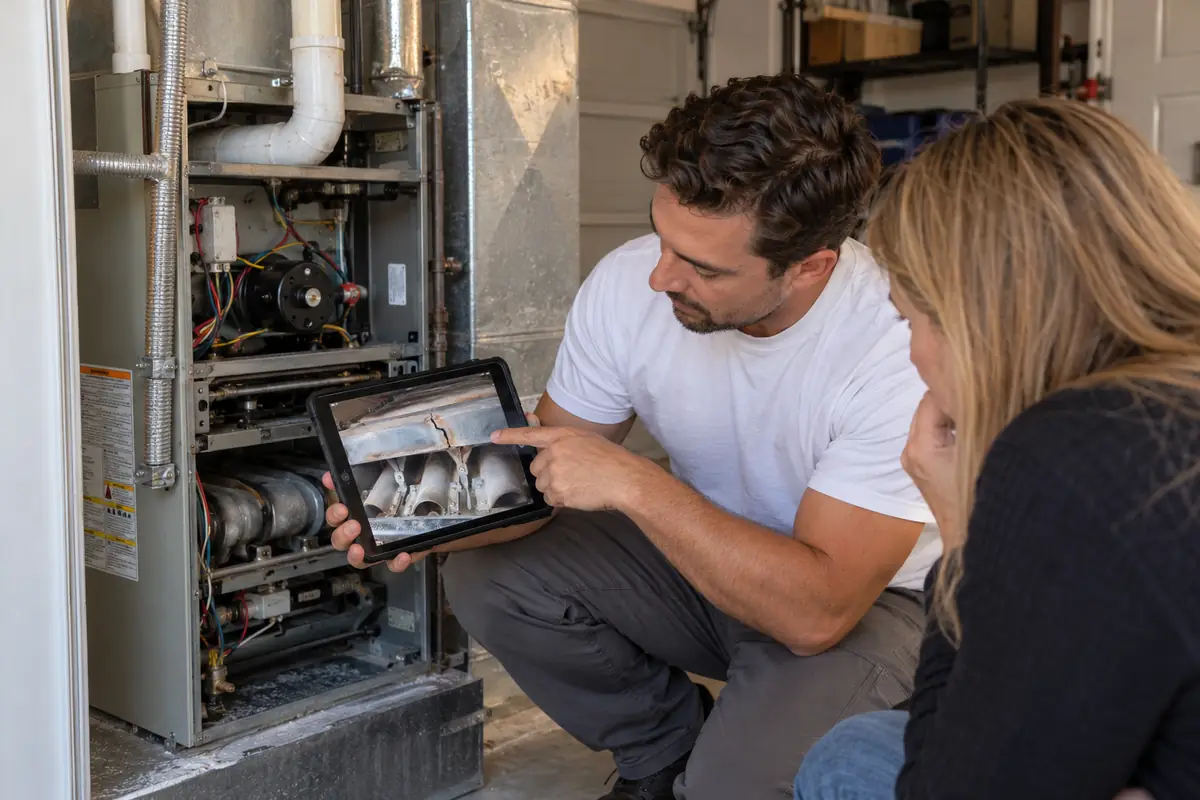
If a technician just told you your heat exchanger is cracked, you’re probably feeling a little rattled. That’s completely understandable. It’s one of the more serious things anyone in my trade can say about a furnace. It usually means the heat has to stay off, and it often comes with a replacement quote attached. Hearing it on one of the first chilly nights of fall makes it even harder.
A cracked heat exchanger is a real safety issue when it’s confirmed, and the furnace shouldn’t run until it’s resolved. But a cracked heat exchanger diagnosis should always come with evidence, and once it’s confirmed, you usually have more than one good option.
I wrote this to walk you through it the way I would if I were standing next to you in your garage: what this part does, how a crack is actually confirmed, what you can and can’t tell on your own, and the questions I’d want answered before approving work on my own home.
What the heat exchanger does, and why a crack matters
Think of the heat exchanger as the wall between your furnace’s flame and the air you breathe. The burners heat a set of metal chambers or tubes. Your home’s air blows across the outside of that metal and warms up, while the combustion gases stay inside and leave through the vent pipe. Its whole job is to keep those two airstreams apart.
That metal heats up and cools down every single cycle. Over many years, all that expanding and contracting can wear it out, especially at seams, bends, and crimps. Overheating speeds things along, and the most common reason a furnace overheats is that it can’t breathe: a clogged filter, closed or blocked registers, or return ducts that are too small for the furnace. High-efficiency furnaces also have a second heat exchanger that handles acidic condensation, and that one can corrode over time.
Here’s why a crack matters. It can let combustion byproducts, including carbon monoxide, into your home’s air. It can also disturb the burner flame when the blower kicks on, which can lead to poor combustion or flame rollout (when flame escapes the area it’s supposed to stay in). That’s why a confirmed crack means the furnace stays off, and why no one should offer to weld, seal, or patch it.
One thing I wish more people knew: on many furnaces, the inside of the heat exchanger runs at a lower pressure than the air around it, so a small crack doesn’t always push gases into the house. That doesn’t make a crack okay. It just means the real risk depends on the size and location of the crack, the type of furnace, and how it’s running. That’s exactly why careful testing matters so much more than a quick look.
What you might notice, and what takes testing
There are a few things you might notice that can point toward a heat exchanger problem. None of them proves one, though.
- A carbon monoxide alarm that goes off while the furnace is running
- Burner flames that flicker, lift, or change shape the moment the blower comes on (only look through the little viewing window, if your furnace has one)
- Soot or scorch marks around the burner area or on the furnace cabinet
- A furnace that keeps shutting itself off on a safety switch
- Headaches, nausea, or dizziness in the household that get better when everyone’s away from home
Each of these has other possible explanations, and some are much simpler fixes. Soot can come from dirty or out-of-adjustment burners. A safety switch can trip because of a blocked vent or a tired draft fan. And a CO alarm can be set off by a water heater, a gas range, a fireplace, or a car warming up in an attached garage. So think of a symptom as a good reason to have the furnace checked, not as the answer.
A few things I’d gently ask you not to do: please don’t take off the burner or blower panels to look inside, don’t keep resetting a safety switch just to get the heat back, and never unplug or remove a CO alarm because you think it’s acting up. If a CO alarm does go off, get everyone (pets too) outside and call 911. Wait until responders tell you it’s safe to go back in. Everything else can wait.
How a crack is actually confirmed
A good diagnosis usually uses more than one method, because each one tells part of the story:
- A look inside, often with a camera. With some parts removed, a technician can use a light, a mirror, or a small flexible camera called a borescope to see places you can’t see from the outside. If there’s a real crack, they should be able to show it to you.
- Combustion testing. A combustion analyzer samples the exhaust and measures carbon monoxide and oxygen while the furnace runs. If the readings jump and stay changed when the blower comes on, that can point to a crack. Small, brief changes can happen for other reasons, like leaky ductwork near the furnace.
- Checking the air in your home. Measuring carbon monoxide in your living space and in the warm air coming from your vents shows whether anything is actually reaching you.
- Watching the flame. How the flame behaves the moment the blower starts can reveal whether air is being pushed or pulled through a gap.
Here’s the standard we hold ourselves to: if we’re going to tell you there’s a crack, we should be able to find it and show it to you. It’s also worth knowing that surface rust, discoloration, and factory seams can look scary without being cracks. Asking for a photo of the exact spot, along with the test readings, isn’t being difficult. It’s being a smart homeowner.
Questions worth asking before you approve anything
These are the questions I’d want answered if it were my own furnace. A good technician will be glad to go through them with you.
- What exactly did you find, and where? Could you show me a photo or video of it on my furnace?
- How did you confirm it? Was it a visual check, a camera, combustion testing, or a combination?
- What were the carbon monoxide readings in the vent, in the warm air, and in the living space?
- Is it safe to run the furnace while I think this over? If the answer is no, keep it off. You may see it tagged as unsafe, which people sometimes call a “red tag.”
- Is the heat exchanger still under warranty? Manufacturers often cover heat exchangers longer than other parts, but it depends on the model, registration, and installation, and labor coverage varies.
- What caused it? If the furnace overheated because it wasn’t getting enough air, that’s worth fixing too, so the new part or new furnace doesn’t run into the same problem.
- What are all my options, and why do you recommend this one?
And please don’t feel awkward about getting a second opinion. For a big safety call like this, it’s completely normal, and any contractor worth hiring will understand. (If you end up comparing two recommendations, it helps to know why HVAC replacement quotes vary so much.) While you decide, if your furnace was flagged as unsafe, keep it off and stay warm safely. Electric space heaters used according to their instructions are fine, but never use an oven, grill, or outdoor heater to warm the house. PG&E customers can also schedule a free gas appliance safety check. It’s a general look at your gas appliances rather than a full furnace inspection, but it’s a nice independent check.
Your options once a crack is confirmed
Patching isn’t on the list, but you still have real choices:
- Replace the heat exchanger. This can be a great fit when the furnace is fairly young, the rest of it is in good shape, the part is available, and it’s still under warranty. It takes some labor, since a good portion of the furnace has to come apart, but it can keep a solid furnace going for years.
- Replace the furnace. This usually makes more sense when the furnace is older, other major parts are wearing out, the heat exchanger is out of warranty or hard to find, or the repair would cost close to what new heating equipment would.
- Take a fresh look at how you heat your home. If you’re replacing anyway, it’s a good moment to ask whether a heat pump or a ductless mini-split might suit your home better. Bay Area air quality rules are also nudging new gas appliances toward zero-emission equipment over the coming years, so it’s worth asking how that might affect a furnace you’d plan to keep for a long time.
One practical note: replacing a furnace usually requires a permit and an inspection, so it’s fair to ask whether that’s included in any quote you receive.
A few things that are different about SF and Marin homes
Our homes have a lot of character, and that character shapes both why problems happen and how we fix them:
- Furnaces in tight spots. Many older San Francisco homes have furnaces tucked into garages, basements, or closets. When a furnace doesn’t have much room to pull in air, it can run hotter and burn less cleanly.
- Ductwork that’s been through a few remodels. Additions and renovations often leave the original ducts serving more space than they were built for, which is also why one room can run hotter or colder than the rest. Undersized return ducts are a classic cause of overheating, so checking airflow belongs in the conversation.
- Vent pipes that have shifted. Settling and the occasional earthquake can loosen or misalign a furnace’s vent connection, and that can cause symptoms that look a lot like a heat exchanger problem. A thorough inspection checks the venting too, not just the furnace.
And whatever shape your furnace is in, it’s worth a quick check of your carbon monoxide alarms. California requires them in single-family homes with gas appliances, a fireplace, or an attached garage. If yours are getting older or haven’t been tested in a while, this is a great week to take care of it.
Frequently asked questions
Can a cracked heat exchanger be repaired? Unfortunately, no. A crack can’t be safely welded, sealed, or patched. The safe options are replacing the heat exchanger itself or replacing the furnace.
Is it safe to run my furnace with a cracked heat exchanger? It isn’t. Once a crack is confirmed, the furnace should stay off until the heat exchanger or the furnace is replaced. In the meantime, stay warm with safe options like electric space heaters, and never use an oven, grill, or outdoor heater indoors.
Will a carbon monoxide alarm always catch a cracked heat exchanger? Not always. Depending on the crack and how the furnace is running, it may not release enough CO to set off an alarm at any given moment. Alarms are still one of the best protections you have, and California requires them in single-family homes with gas appliances, a fireplace, or an attached garage, on each level and outside sleeping areas.
Is a heat exchanger covered by warranty? Often, yes, and frequently for longer than other furnace parts. Coverage depends on the manufacturer, the model, whether the furnace was registered, and how it was installed. Labor coverage varies, so it’s worth asking for the details in writing.
How can I tell if a cracked heat exchanger diagnosis is accurate? The simplest step is to ask how it was confirmed. A reliable diagnosis usually combines a visual or camera inspection with combustion testing, and your technician should be able to show you the exact spot on your furnace along with the test readings.
If you’re in this spot right now
If you’ve just been told your heat exchanger is cracked, here’s my honest advice: ask to see the evidence, keep the furnace off if it was flagged as unsafe, and get a second look before you commit to anything big. We’d be glad to come out, inspect your furnace, and walk you through exactly what we find, with photos and test readings, in plain language. Then we’ll talk through whether replacing the heat exchanger, replacing the furnace, or switching systems makes the most sense for your home. If replacement does turn out to be the right call, estimates are free. You can reach us at (628) 289-3552 or request a visit through our contact page.