
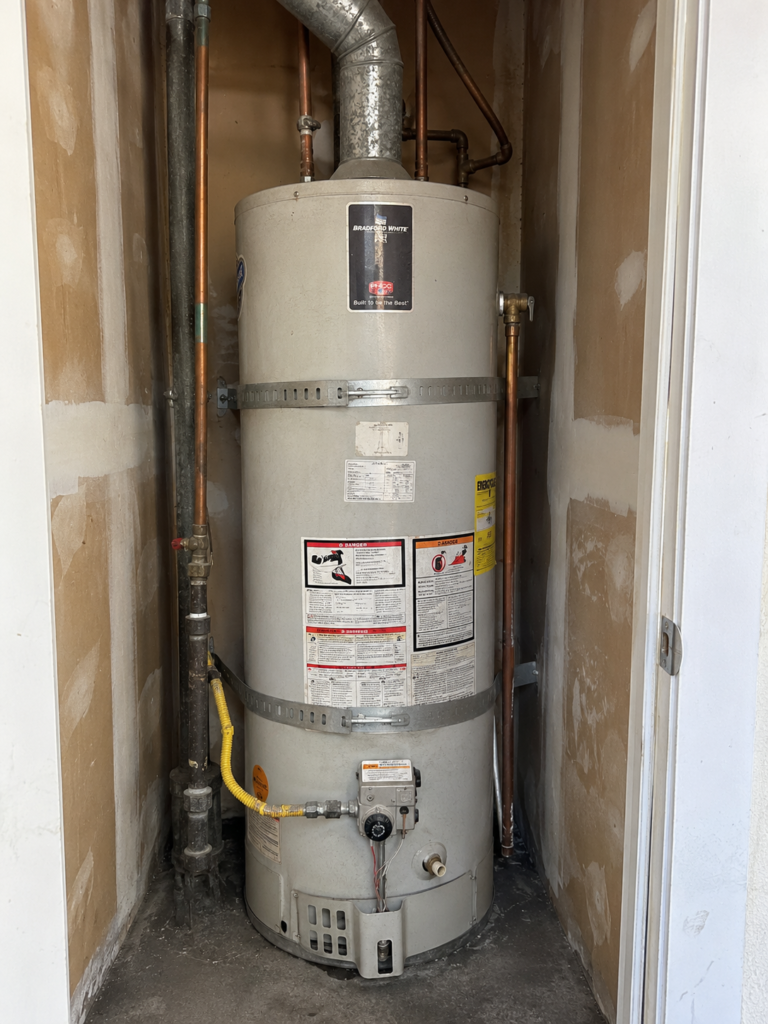
If you’ve heard that gas water heaters are about to be banned in the Bay Area, here’s the short version: nobody is coming for the water heater in your garage. The Bay Area gas water heater rule applies only when a water heater is replaced, its start date is likely to move, and the proposed exemptions are aimed at exactly the kinds of constraints older San Francisco and Marin homes tend to have.
What the rule does change is how much it helps to know your options before the tank fails on a Sunday night.
What the rule actually says
The rule is Regulation 9, Rule 6 of the Bay Area Air District, the regional air quality agency for nine counties including San Francisco and Marin. In 2023 the district amended it to set a zero-NOx standard for new water heaters. NOx is short for nitrogen oxides, a byproduct of burning gas that contributes to smog.
No gas water heater on the market today meets a zero-NOx standard. In practice, that means a replacement installed after the start date would be electric. Among the electric water heater options, the practical choice for most homes is a heat pump water heater.
Three details matter more than the headlines suggest:
- It applies at replacement only. A working gas water heater can stay in service and be maintained for as long as it lasts.
- The date on the books is January 1, 2027. That covers the typical residential tank water heater. Larger equipment, which includes most gas tankless units, falls under a later 2031 date.
- It covers new units sold or installed in the district. It is not a requirement to remove anything.
What’s proposed, and what isn’t settled yet
In July 2026 the Air District released draft amendments that would change the rule in two ways.
First, the start date would move from January 2027 to January 2028.
Second, the draft adds exemptions. The district expects most to fall into three groups:
- Income. Low-income property owners, including participants in programs such as Medi-Cal or CalFresh, and households paying more than 28 percent of their income toward mortgage and property taxes.
- Space. Properties without enough room or ventilation to install a compliant unit.
- Electrical. Panels below 100 amps, panels without enough spare capacity, or homes that would need electrical lines run more than 50 feet.
The public comment period has closed, and the district’s board is tentatively scheduled to consider the amendments in November 2026. Until the board votes, January 2027 remains the official date, and the final exemption language could differ from the draft. We’ll update this article once a decision is made.
Why older San Francisco and Marin homes are the hard cases
A gas water heater makes heat with a burner. A heat pump water heater moves heat out of the surrounding air and into the tank, the way a refrigerator works in reverse. That difference is why it uses far less energy, and also why it asks more of the space it sits in.
It needs air to work with. Manufacturers specify a minimum amount of surrounding air, or a louvered door or ducting to make up for it. A two-car garage in Novato is easy. A water heater closet under the stairs of a Richmond District flat is not.
It is usually bigger. Heat pump models tend to be taller, and often wider, than a gas tank of the same capacity. In a low-ceilinged alcove or a hillside crawlspace, a few inches decide the question.
It needs the right electrical supply. Many models need a dedicated 240-volt circuit. Newer 120-volt models plug into a standard outlet, which avoids panel work but comes with slower recovery. That trade-off suits some households and frustrates others. Older homes with small panels may not have room for a new circuit at all, which we covered in our article on electrical panels and heat pump equipment.
It produces condensate. Pulling heat out of air also pulls out moisture, so the unit needs a drain or a small pump nearby.
It cools the space around it and makes some sound. In a garage, most people never notice. In an interior closet beside a bedroom, both are worth thinking through first.
None of this makes a heat pump water heater a bad choice. It means the answer depends on the house, and a good installation starts with someone looking at the space instead of quoting from a photo of the old tank.
What you can check yourself
You can learn a lot in ten minutes without touching anything.
- Age. The rating label on the tank usually shows a manufacture date, sometimes coded into the serial number. Many tank water heaters last somewhere around 10 to 15 years.
- Condition. Rust-colored hot water, rumbling or popping as the tank heats, moisture or corrosion at the base or fittings, and running out of hot water sooner than you used to are all worth noting.
- Location. Garage, closet, crawlspace, or outdoor enclosure? Note the ceiling height, how much open room is around the tank, and whether a floor drain or laundry sink is nearby.
- Electrical. Is there an outlet near the water heater? With the panel door open, the number on the main breaker tells you the size of your electrical service. Look only. Don’t remove the panel cover.
What takes a professional evaluation
Some answers can’t come from looking.
- Whether the panel has real spare capacity, which takes a load calculation, not a count of empty breaker slots
- Whether the existing gas venting and gas connection are in safe condition right now
- Whether the location meets the clearance and air requirements for a specific model
- What tank size fits your household, since a heat pump model recovers more slowly than a gas burner and is often sized up
- Whether your home would likely qualify for one of the proposed exemptions
A few things not to do: don’t attempt gas, venting, or electrical work yourself, and don’t keep relighting a pilot that won’t stay lit. If you ever smell gas, leave the house and call PG&E or 911 from outside.
Three situations, three reasonable paths
Your water heater is fairly new and working well. Keep up with water heater maintenance and carry on. The rule doesn’t touch it.
It’s past ten years old or showing signs of wear. This is the group with the most to gain from acting early. An evaluation now tells you whether your home is a simple fit for a heat pump water heater, needs electrical work first, or probably falls under an exemption. A planned replacement leaves time for permits, any panel work, and rebate applications. An emergency replacement leaves time for none of that.
You’re wondering whether to install a new gas unit before the deadline. Sometimes that’s a sensible conversation, particularly when the tank is near the end of its life and the home is a difficult fit. But replacing a healthy water heater early throws away the years it has left, and the proposed exemptions may cover the difficult homes anyway. It’s a decision to make from the facts of your house, not from a headline.
Questions worth asking any contractor
- Will a heat pump water heater work in the current location, and what would have to change?
- Did you run a load calculation on my panel, or just look at it?
- Would you recommend a 240-volt or a 120-volt model for my household, and what do I give up with each?
- Where will the condensate drain?
- What tank size are you proposing, and why?
- Which rebates apply to my address, and who files the paperwork?
- If my home would qualify for an exemption, what documentation is involved?
A contractor who answers these plainly has looked at your house. One who can’t has looked at a price sheet.
What about gas furnaces?
Furnaces fall under a separate rule, Rule 9-4, with a zero-NOx standard scheduled for 2029. The current amendments deal with water heaters only. If you’re weighing your heating options, our comparison of a heat pump or a furnace is a good place to start.
The useful next step
If your water heater is more than ten years old, find out this fall which of those three situations your home is in. Bay Air can look at the existing tank, the space, and the electrical side, and tell you what a replacement would involve at your address, whether that’s next month or several years from now. Estimates for water heater replacement in San Francisco and Marin are free, and you can reach us at (628) 289-3552 or through bayairservices.com.
Frequently asked questions
Do I have to replace my working gas water heater?
No. The rule applies only when a water heater is replaced. An existing gas unit can stay in service and be maintained for as long as it lasts.
Can I still have a gas water heater installed in San Francisco or Marin County right now?
Yes, as of October 2026. The official start date for the zero-NOx standard on typical residential tank water heaters is January 1, 2027, and the Air District has proposed moving it to January 2028. The board is expected to consider that change in November 2026.
Will a heat pump water heater fit in a small water heater closet?
Sometimes. It depends on the model’s height and width, how much air the closet provides or can be given through a louvered door or ducting, and whether there’s a place for condensate to drain. This is one of the situations the proposed space exemption is meant to address.
What happens if my water heater fails after the rule starts and my home can’t accommodate an electric one?
The draft amendments include exemptions for space-constrained properties, limited electrical service, and lower-income owners. The final wording isn’t adopted yet, so the exact process and paperwork are still to come.
Does this rule affect gas furnaces or gas stoves?
Furnaces are covered by a separate rule with a zero-NOx standard scheduled for 2029. Gas stoves are not part of either rule.