
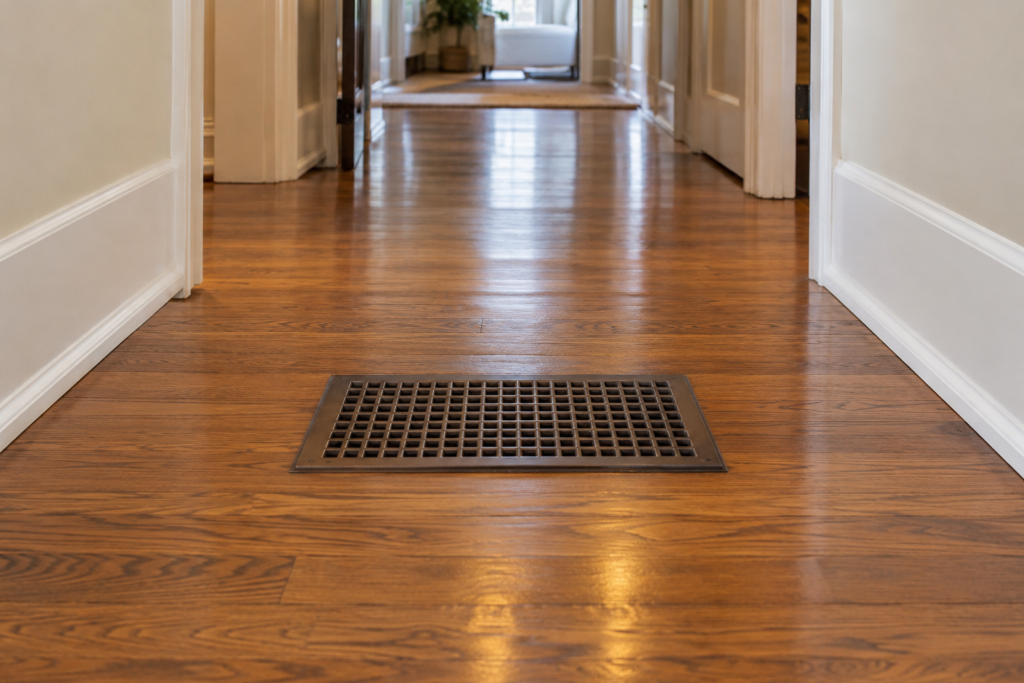
If your heat comes from a metal grille in a hallway wall or a grate set into the floor, most of the furnace advice online wasn’t written for you. Search “furnace not heating” and you’ll be told to change the filter, check the blower, and look for leaky ducts. A typical wall or floor furnace has no ducts, often no filter, and sometimes no blower at all.
That difference matters when something goes wrong. It also matters when you’re deciding whether to repair the unit you have, replace it with something similar, or move to a different kind of system. Here’s how these heaters actually work, what their common problems usually mean, and how to think through the decision without being rushed into it.
How wall and floor furnaces differ from central furnaces
Wall furnaces and floor furnaces fall into a category the Department of Energy calls direct heating equipment. Instead of pushing warm air through ductwork to every room, they heat the space they’re installed in, and the heat spreads from there.
They come in a few common types:
- Gravity wall furnaces have no blower. Air warmed by the burner rises out of the top grille, and cooler air is drawn in at the bottom. They’re quiet and simple, with fewer parts to fail.
- Fan-type wall furnaces add a small blower to push warm air farther into the room. They move heat more effectively, but they add a motor and some electrical components.
- Floor furnaces hang from the floor framing, with the burner compartment in the crawlspace and a grate flush with the floor above. Warm air rises straight up through the grate.
Many older units use a standing pilot light and a millivolt control system. That means a small flame burns continuously, and a thermocouple or thermopile next to it generates the tiny electrical signal that keeps the gas valve open. No household electricity is involved. This detail becomes important later, especially if you’re thinking about a new thermostat.
There’s also an efficiency gap. Current federal minimum efficiency standards for new gravity wall furnaces sit in the mid-60 percent range, and fan-type models in the mid-70s. Units installed decades ago may perform below that. A meaningful share of the heat these heaters produce goes up the vent rather than into the room.
Why the back bedroom is always cold (and why that’s not a malfunction)
One of the most common complaints about wall and floor furnaces is [uneven heat](PLACEHOLDER: “Why Is One Room Always Hotter or Colder Than the Rest of the House?” URL). The hallway or living room gets warm, and the bedrooms at the end of the house never catch up.
Usually that isn’t a failing heater. It’s a single heat source in one location trying to warm rooms it has no direct path into. Closed doors, long hallways, and additions built after the original heater make it worse.
A repair won’t fix a layout problem. If uneven heat is your main complaint and the unit is otherwise running properly, that’s a sign to look at your options rather than to keep paying for service calls.
Common problems and what they usually point to
Some symptoms you can observe safely. Others only tell you something is wrong, not what. Here’s how to read the most common ones.
The pilot won’t stay lit. This is often a worn thermocouple, a dirty pilot assembly, a draft blowing the flame out, or a gas valve problem. You can see that it’s happening, but not which cause it is. If it goes out repeatedly, stop relighting it and have it checked. If you ever smell gas, leave the house and call PG&E or 911 from outside.
The burner lights, then shuts off before the room warms up. A safety limit may be tripping because the unit is overheating. Blocked return airflow (furniture or a rug pushed against the bottom of a wall grille), a failing fan on a fan-type unit, or a venting issue can all cause this. The symptom looks the same in each case, which is why testing matters.
A fan-type unit is noisy or blows weakly. Lint buildup, a worn motor, or failing bearings are the usual suspects. Don’t open the cabinet to clean near the burner or wiring yourself.
A burning-dust smell on the first cold night. A brief smell the first time the heater runs each season is usually dust burning off. A smell that persists, or any sign of soot, is different.
Soot, scorch marks, or discoloration around the grille or the wall above it. This points to incomplete combustion or a venting problem. Turn the heater off and have it inspected before using it again.
Your carbon monoxide alarm goes off. Get everyone outside, then call 911 or PG&E. Every home with a gas heater should have working CO alarms near sleeping areas, and older units deserve that extra layer of protection.
What a technician actually checks
A proper inspection on a wall or floor furnace goes beyond lighting the pilot and watching it run. Depending on the unit, a technician may:
- Measure the thermocouple or thermopile output to see whether it’s producing enough voltage to hold the gas valve open
- Check gas pressure and inspect the burner and pilot flame for size, color, and stability
- Inspect the combustion chamber and heat exchanger for cracks, rust-through, or separation
- Confirm the vent connector is intact and that the heater is drafting properly, so combustion gases leave the house
- Test for carbon monoxide at the appliance
- Check clearances to walls, doors, curtains, and furniture
- For floor furnaces, look at conditions in the crawlspace: moisture, debris in the pit below the unit, and how the unit is supported
That last group of checks answers the bigger question. A thermocouple can be replaced in a single visit. A cracked heat exchanger changes the conversation entirely.
What not to do
- Don’t block the grille. Codes require clearance around these heaters for a reason. Floor furnace registers, for example, need distance from walls, doors, and draperies. Keep rugs, furniture, curtains, and laundry well away.
- Don’t cover a floor grate to keep kids or pets off it. A cover traps heat and creates a fire risk. A freestanding gate around the grate is the safer approach.
- Don’t run a floor furnace with the grate removed, and don’t drop anything through it.
- Don’t keep relighting a pilot that won’t stay lit. It’s telling you something.
- Don’t buy a standard smart thermostat and assume it will work. Most smart thermostats need 24-volt power. Many wall and floor furnaces use a millivolt system, which needs a thermostat designed for it. Installing the wrong one can mean a heater that won’t respond, or that won’t shut off.
Repair, replace, or upgrade: how to decide
Repair usually makes sense when the heat exchanger and venting check out, the problem is isolated to a replaceable part (a thermocouple, pilot assembly, or fan motor), parts are available, and the heater keeps the space reasonably comfortable. A sound wall furnace with a worn part is often worth fixing. Replacing an entire system to solve a small problem rarely makes financial sense.
Like-for-like replacement deserves consideration when the heat exchanger is cracked or rusted through, parts are no longer made, or the unit keeps failing in different ways. Replacement wall furnaces are still manufactured, and some can fit an existing wall opening, though the fit and the vent both need to be verified. Floor furnaces have fewer replacement options, and the work can involve the crawlspace and floor framing.
An upgrade is worth weighing when uneven heat is the real problem, you’d also like cooling, or the unit is near the end of its life anyway. A [ductless mini-split heat pump](PLACEHOLDER: Aug 26 shoulder-season heat pump post URL) is the most common alternative. It can heat and cool, it can serve more than one room with separate indoor units, and there’s no combustion happening inside your living space.
Mini-splits come with their own questions. Does your electrical panel have capacity? Where can the indoor and outdoor units go? Do you need HOA or building approval? And the old heater’s gas line and vent opening need to be properly capped and sealed, not just abandoned.
There’s also a regional factor. Under amendments adopted by the Bay Area Air Quality Management District, new natural gas furnaces sold or installed in the Bay Area must meet a [zero-NOx standard](PLACEHOLDER: Gas water heater rule post URL) starting in 2029. That doesn’t require you to remove a working heater. But if yours is nearing the end of its life, it’s reasonable to factor in what replacement options will look like in a few years.
What this looks like in San Francisco and Marin homes
Wall and floor furnaces are common in the region’s flats, older bungalows, and condo buildings, where adding ductwork was never practical. Those same constraints shape the upgrade options.
In a San Francisco flat or condo, an outdoor unit may need building approval, and placement can be limited by shared walls and narrow side yards. In parts of Marin, a floor furnace may sit in a tight, damp crawlspace that deserves a look for moisture regardless of what you decide. Near the coast, salt air is worth considering when choosing where an outdoor unit goes and what protection it needs.
None of this rules anything out. It just means the right answer depends on the specific home, not a one-size recommendation.
Questions to ask before approving any work
- What exactly failed, and how did you test it?
- Did you inspect the heat exchanger and venting, and what did you find?
- Is this part still available, and is the rest of the unit in good enough shape to justify the repair?
- If replacing, will the new unit fit the existing opening and vent, and does the job need a permit?
- If upgrading to a mini-split, does my panel have capacity, and where would the indoor and outdoor units go?
A good technician should be able to answer each of these plainly.
Frequently asked questions
Are wall furnaces safe?
When they’re properly installed, vented, and maintained, yes. The main risks are carbon monoxide from a venting or heat exchanger problem, burns from hot surfaces, and fire when combustibles sit too close. An inspection plus working CO alarms covers most of that.
Can I put a smart thermostat on my wall furnace?
Sometimes, but not just any model. Many wall and floor furnaces run on millivolt controls, and most smart thermostats need 24-volt power. Check what your heater uses before buying.
Can a ductless mini-split replace a wall furnace?
In many homes, yes. It depends on electrical capacity, where indoor and outdoor units can go, and any building or HOA approval. A mini-split can also add cooling and serve rooms the old heater never reached.
Do I have to replace my gas wall furnace because of the Bay Area’s new rule?
No. The air district’s zero-NOx requirement applies to new furnaces sold or installed starting in 2029. Existing heaters can keep operating.
Why does my floor furnace grate get so hot?
That’s how it heats. Warm air rises straight through the grate. Keep the area clear and use a freestanding gate if you have small children or pets.
If your wall or floor furnace won’t hold a pilot, is leaving soot behind, or simply can’t keep the far rooms warm, have it inspected before deciding anything. Bay Air Heating & Cooling will test the unit, show you what we found, and lay out repair, replacement, and upgrade options side by side. Our approach is to keep a sound system running whenever that’s the better choice. You can schedule a visit through bayairservices.com or call (628) 289-3552.