The thermostat says HEAT. You can hear the system running. But when you hold your hand over the register, the air feels cool, and the house isn’t warming up the way it should.
Sometimes that means something has failed. Often, though, the system is doing exactly what it was designed to do, especially during the first cold evenings of fall. Telling the two apart depends on what kind of system you have, where your ducts run, and a few details you can observe without opening anything up.
The short version: if your home’s temperature is slowly rising toward the setpoint, the system is probably working, even if the air feels less than hot. If the temperature is flat or falling, or the cool air never lets up, something needs attention.
Start With Three Questions
Before you look at causes, answer these. They narrow things down faster than any checklist.
Is the house actually getting warmer? Watch the thermostat for 20 or 30 minutes. A slow, steady climb means heat is being delivered. No change at all points to a real problem.
Is it every room, or just one or two? Cool air throughout the house usually points to the equipment or the thermostat. Cool air in only some rooms usually points to the ductwork.
Is it constant, or does it come in spells? Brief periods of cooler air at the start or end of a cycle, or every so often on a heat pump, are often normal. Air that stays cool for the whole cycle is not.
Keep your answers in mind as you read the rest.
Furnace or Heat Pump? It Changes What “Warm” Feels Like
A gas furnace burns fuel and typically sends air well above 100 degrees to the registers near it. That air feels unmistakably hot.
A heat pump works differently. It moves heat from the outdoor air into your home rather than creating it by burning fuel, and its supply air is often in the 90s. That’s warmer than your room, but cooler than your skin can register as “hot,” so it can feel lukewarm or even cool against your hand. It’s normal. A heat pump makes up for it by running longer, steadier cycles. (If you’re still weighing the two systems, our guide Heat Pump or Furnace? walks through the tradeoffs.)
If you recently switched from a furnace to a heat pump, cooler-feeling air is often not a sign that anything is wrong. The better test is whether the house holds its temperature.
Common Causes That Aren’t Actually Failures
The thermostat fan is set to ON instead of AUTO
With the fan on ON, the blower runs constantly, including between heating cycles. Whenever the burners or compressor are off, you’ll feel room-temperature air moving through the vents, and it will feel cool. Switch the fan to AUTO and see whether the problem goes away. This is the most common cause, and it’s the easiest one to check.
The start and end of a furnace cycle
Most furnaces wait for the heat exchanger to warm before the blower starts. Most also keep the blower running briefly after the burners shut off to pull out the remaining heat. The last minute of a cycle can feel cool. If your ducts pass through a cold garage or crawlspace, the first puff of air at startup may feel cool too, because it’s air that was sitting in cold ducts.
A heat pump defrost cycle
On cold, damp mornings, frost can build up on a heat pump’s outdoor coil. To clear it, the system briefly reverses and runs in cooling mode, sending heat outdoors to melt the frost. You may hear a whoosh from the outdoor unit and see steam rising from it. Steam is normal. It is not smoke.
Many systems turn on backup heat during defrost so you don’t notice. Systems without backup heat, or with backup heat that isn’t working, can blow noticeably cool air for a few minutes. Defrost cycles are less frequent in most of San Francisco, where freezing mornings are uncommon. They’re more likely on clear, cold mornings in Marin’s inland valleys. For more on how local weather affects heat pump performance, see Do Heat Pumps Work in San Francisco’s Fog?
Check the Thermostat Before Anything Else
A surprising number of “no heat” problems start at the thermostat:
- Mode: Make sure it’s set to HEAT, not COOL or AUTO, and that the setpoint is above the current room temperature.
- Power: Weak batteries can cause erratic behavior on thermostats that use them.
- A recently replaced thermostat: A heat pump thermostat has to be configured to match how that system switches between heating and cooling. If a new thermostat was set up incorrectly, the system can run in cooling mode when you ask for heat. If the problem started right after a thermostat change, tell your technician. It’s an important clue.
When a Furnace Blows Cold Air
The burners aren’t lighting, or aren’t staying lit
If the burners fail to light, or light and then shut off after a few seconds, any air the blower moves will be cool. A dirty or failing flame sensor is one common reason. Ignition problems, gas supply issues, and venting safety controls can cause the same symptom. After several failed attempts, many furnaces lock themselves out and stop trying.
The furnace is overheating and shutting itself down
This cause gets misdiagnosed often. Every furnace has a high-limit switch that shuts off the burners if the furnace gets too hot. The blower keeps running to cool it down, so you feel cool air.
The usual reason a furnace overheats is restricted airflow. That can be a clogged filter, closed or blocked registers, undersized return ducts, or a crushed or disconnected duct. The switch is doing its job. Replacing it, as some repairs do, won’t fix anything if the airflow problem stays. Repeated overheating also stresses the heat exchanger, so it’s worth finding the real cause. Our post on signs your furnace needs repair before winter covers other early warnings worth knowing.
Other safety shutdowns
Many high-efficiency furnaces also shut down if their condensate drain backs up or if a venting safety switch senses a problem. In these cases, a status light blinking in a specific pattern is often the best clue a homeowner can gather.
When a Heat Pump Blows Cold Air
Beyond defrost, the warning signs are:
- Cool air that continues long after a defrost cycle should have ended
- Ice on the outdoor unit that doesn’t clear
- An outdoor unit that goes into defrost unusually often
- A house that can’t recover to its setpoint
Possible causes include low refrigerant, which almost always means there’s a leak. Others are a reversing valve that’s stuck or failing, faulty defrost controls, outdoor fan problems, or backup heat that isn’t working. None of these can be confirmed from symptoms alone. Refrigerant work in particular requires EPA certification and proper instruments. Our article on refrigerant charge and superheat explains why “just adding refrigerant” rarely solves the real problem.
Cold in One Room, Warm Everywhere Else? Look at the Ducts
If most of the house is warm and one or two rooms get cool air, the equipment is probably fine. The heat is getting lost on the way.
This is common in older San Francisco and Marin homes. In many SF houses, the living space sits above a garage, and the heating ducts run through that unheated space. Older Marin homes often have long duct runs through crawlspaces. Additions and remodels sometimes tie new rooms into ductwork that was never sized for them.
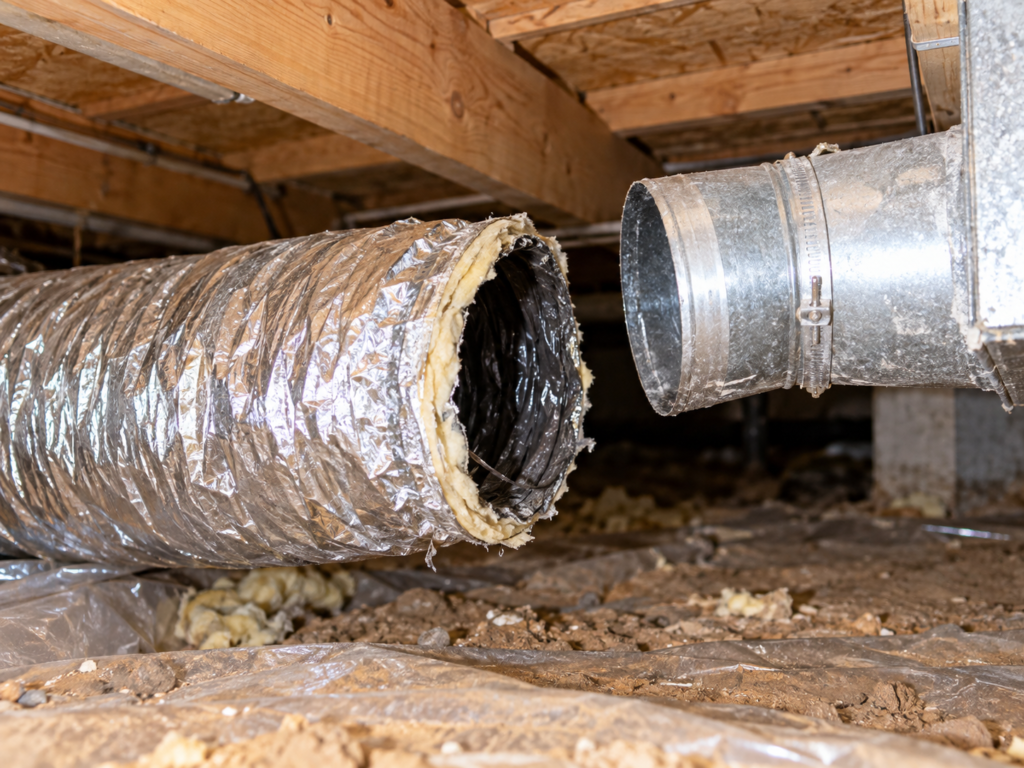
A duct that has come apart, been crushed during other work, or lost its insulation can cool the air significantly before it reaches the room. From inside the room, that looks exactly like an equipment problem. If rooms get noticeably colder during wet weather, read Why Your House Gets Cold When It Rains for a closer look at how damaged ductwork loses heat. Bay Air also offers duct inspection and repair when the problem is in the ducts rather than the equipment.
What You Can Safely Check
- Set the thermostat to HEAT, set the fan to AUTO, and put the setpoint a few degrees above room temperature.
- Replace the air filter if it’s dirty, and note the airflow arrow on the frame.
- Make sure supply registers and return grilles are open and not blocked by furniture, rugs, or curtains.
- Confirm the furnace’s service switch (it usually looks like a light switch near the unit) is on. Check whether a breaker has tripped. If a breaker trips again after one reset, leave it off.
- If you can see the furnace’s status light through its viewing window, write down the blink pattern. Don’t remove any panels to find it.
- For a heat pump, look at the outdoor unit from a short distance. Heavy ice that stays or debris blocking the unit is worth noting.
- Note when the problem started, and whether anything changed around that time: a new thermostat, a new filter, or work done in the crawlspace, garage, or attic.
What Not to Do
- Don’t remove furnace access panels, and don’t bypass or jumper any safety switch.
- Don’t try to relight burners or adjust gas components.
- Don’t chip ice off a heat pump coil or pour hot water on it. The fins and refrigerant lines are easy to damage.
- Don’t add refrigerant or use DIY recharge kits.
- Don’t close a lot of registers to push heat into cold rooms. It raises duct pressure and can make overheating shutdowns more likely.
- If you smell gas (a rotten-egg or sulfur odor), leave the house right away and call 911 from outside, then PG&E. PG&E’s gas safety page lists the warning signs of a leak.
If your system is also giving off an unusual smell during its first few runs of the season, see Why Your Furnace Smells Like Burning the First Time You Turn On the Heat This Fall.
What a Technician Will Actually Check
A thorough diagnosis goes further than looking for the broken part:
- Temperature rise across a furnace: the difference between return and supply air, compared with the range on the unit’s rating plate
- Static pressure: whether airflow is being restricted
- The ignition sequence: how the furnace lights, including the flame sensor signal
- Stored fault codes: any the control board has saved
- Heat pump performance: refrigerant pressures and temperatures, reversing valve operation, defrost controls, and whether backup heat is actually running
- Thermostat wiring and configuration
- Duct connections and insulation: checked in the garage, crawlspace, or attic
Questions Worth Asking Before You Approve a Repair
- What caused this part to fail, and will replacing it fix the underlying problem?
- If the limit switch or flame sensor is involved, why did it trip or fail in the first place?
- If refrigerant is low, where is the leak, and will it be found and repaired or just recharged?
- Was the temperature rise or system performance measured before and after the repair?
- Does this fix the whole-house complaint, or only one symptom?
Frequently Asked Questions
Is it normal for a heat pump to blow cool air in winter?
Brief periods of cooler air during a defrost cycle are normal, and heat pump air generally feels less hot than furnace air. Cool air that continues for a long time, or a house that won’t reach its setpoint, is worth having checked.
Why does my furnace blow cold air at the end of a cycle?
Most furnaces run the blower briefly after the burners shut off to pull out the remaining heat. The last bit of air can feel cool. That’s normal.
Can a dirty filter make my furnace blow cold air?
Yes. A clogged filter restricts airflow, which can make the furnace overheat. A safety switch then shuts off the burners while the blower keeps running.
Should I switch my heat pump to emergency heat?
If your system has backup heat, emergency heat can keep the house warm temporarily. It’s usually much more expensive to run, though, and it doesn’t fix whatever is wrong with the heat pump.
Why is only one room getting cold air?
The cause is usually the ductwork, not the equipment. Leaking, disconnected, or poorly insulated ducts in a garage, crawlspace, or attic are common culprits.
If the Air Is Still Cool
If you’ve checked the thermostat, filter, and vents and the air still stays cool, write down what you’ve observed:
- Whether you have a furnace or a heat pump
- Whether it affects the whole house or only some rooms
- Whether the cool air is constant or comes in spells
- Any blink code
- When it started
Those details give a technician a head start. Bay Air Heating & Cooling provides heating diagnostics and repair for furnaces, heat pumps, and ductwork throughout San Francisco and Marin County. We explain what we find before recommending anything, and we’ll tell you honestly when a repair makes more sense than replacing equipment. You can schedule a heating diagnostic online.
Sources and Further Reading
- U.S. Department of Energy, Energy Saver: Air-Source Heat Pumps
- PG&E: Gas Safety