
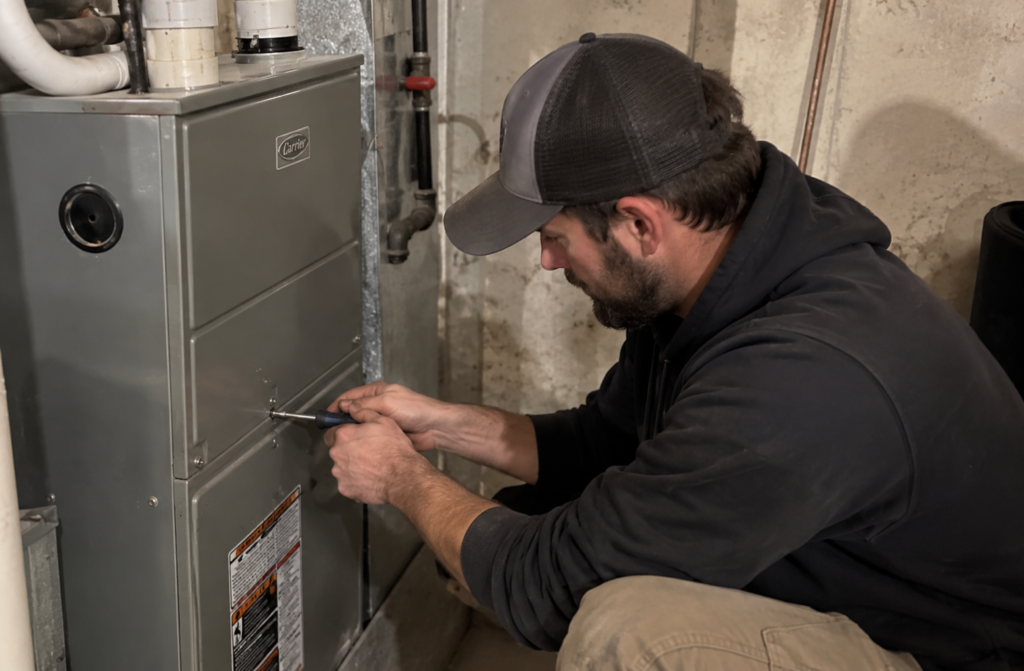
You flip the thermostat over to heat for the first time this fall, and within a few minutes there’s a smell coming through the vents that makes you wonder if something is wrong. In San Francisco and Marin County, where a mild, fog-cooled climate means many furnaces barely run at all for most of the year, that moment tends to catch homeowners off guard every September and October. If your furnace has been sitting untouched since last winter, or even longer, that smell is worth understanding rather than ignoring, and rather than panicking over.
Why this happens to almost every furnace
During the months your furnace sits idle, a thin layer of dust settles on the heat exchanger, the burners, and the other components that heat up when the system runs. The first time you switch the heat back on, that dust burns off. The result is usually a dry, dusty smell that some people describe as burning hair or hot electronics, even though nothing is actually wrong.
This is normal, and it’s one of the most common reasons a furnace smells like burning at startup. In most cases, the smell fades within about an hour as the dust finishes burning and the air in your ducts turns over. Changing your air filter before you turn the heat on for the season reduces how much dust is sitting in the system to begin with, which is one small step that makes that first startup less noticeable.
A common misconception
A lot of homeowners assume this only applies to older equipment, and that a newer furnace shouldn’t smell like anything at startup. That’s not quite right. Dust settles on any furnace that sits unused for months, regardless of age. A newer system can also produce a faint plastic or oily smell during its first few cycles from factory coatings curing, which fades on its own. Age matters more for a different reason, covered below, than it does for whether that first-run smell shows up at all.
How to tell a normal smell from one that isn’t
The tricky part is that a harmless dust smell and a genuinely concerning one can both start the same way: a burning odor right after you turn the heat on. A few distinctions help sort out which one you’re dealing with.
A faint, dry, dusty smell that clears within an hour and doesn’t return the next time the furnace runs is almost always just dust. No action is needed beyond a filter change if you haven’t already done one.
A musty or damp smell, rather than a dry burning one, usually points to moisture that built up in the ductwork over the summer instead of dust on the furnace itself. That’s a different issue from a startup smell, and one worth mentioning to a technician if it doesn’t clear up after a few heating cycles, since it can be a sign of standing moisture rather than something that simply airs out.
A smell like burning plastic or something electrical isn’t dust. That kind of odor points to a component running hotter than it should, such as a blower motor or a wiring connection, and it’s a reason to turn the furnace off and have it checked before running it again.
A rotten egg smell is the one that should never be treated as a maybe. That odor is added intentionally to natural gas so leaks are noticeable, and it means leaving the house immediately and calling your gas utility or 911 from outside, not troubleshooting from inside.
If a burning smell keeps returning every time the furnace cycles on, rather than fading after that first hour, that pattern on its own is worth a professional look even if nothing else seems obviously wrong.
If it only smells that way in one room
A smell concentrated in a single room, rather than throughout the house, usually says more about that room’s ductwork than about the furnace itself. Localized moisture, a duct run that collects more dust than others, or airflow that isn’t reaching that room properly can all produce a room-specific odor that has little to do with what’s happening at the furnace. That distinction matters because sealing a duct or clearing an obstruction solves a different problem than servicing the furnace does, and treating the wrong one won’t fix what you’re actually smelling.
The smell that matters most is the one you can’t smell
Dust burning off is harmless. Carbon monoxide is not, and the problem with carbon monoxide is that it has no smell at all. A cracked heat exchanger or a venting problem can let carbon monoxide into a home’s air without producing any odor a person would notice, which is exactly why the U.S. Consumer Product Safety Commission recommends a carbon monoxide detector near every sleeping area, along with a professional inspection of fuel-burning heating equipment before each heating season, not just when something seems off. The EPA backs the same guidance and is a good place to check if you’re shopping for a detector and want to know what to look for.
This matters more with older systems and older homes, where a heat exchanger has had more years to develop hairline cracks, and where the furnace itself may be installed in a tight hall closet, a converted attic space, or a crawl space with limited combustion air. A lot of San Francisco and Marin housing stock fits that description, which is one reason a fall safety check is worth treating as routine, separate from whatever smell does or doesn’t show up.
What a fall furnace safety check actually looks at
A proper fall furnace safety check isn’t the same as just waiting for the burning smell to go away. A technician working through a furnace before heating season typically looks at the heat exchanger for cracks or corrosion, the burners and ignition system for proper flame and combustion, the flue and venting for blockages or disconnections, gas pressure and connections, the blower motor and electrical components, and the air filter. The point of that visit is information, not a sales pitch: knowing whether the system is safe and functioning the way it should, and only recommending furnace repair when something specific is actually found.
Questions worth asking before approving any work
If a technician does find something during a fall check, a few questions help you understand what you’re actually being told: What specifically did you find, and where is it? Does this affect safety, or mainly performance? Would a repair address it, or are you recommending replacement, and why that instead of a repair? Can you show me what you’re seeing? A straightforward answer to each of those is a reasonable thing to expect before agreeing to anything.
What not to do
Don’t open the furnace’s electrical compartment or attempt to inspect the heat exchanger, burners, or gas connections yourself. Don’t assume a musty smell from ductwork moisture will resolve on its own if it persists past the first few heating cycles. Most importantly, don’t rely on smell alone to rule out a carbon monoxide problem. Since it has no odor, a working detector is the only reliable way to know, not your nose.
A local quirk worth knowing
Because heating needs in San Francisco and Marin County are so mild and inconsistent compared to most of the country, a lot of homeowners don’t run the furnace continuously once fall arrives. Instead, it gets switched on for a cold morning, then left off again for days while the weather stays mild. That on-and-off pattern means the “first startup of the season” moment can effectively happen more than once between September and December, and it also means an older furnace tucked into a closet or crawl space can go a long time without anyone paying attention to it. That’s exactly the situation a single scheduled fall check is meant to cover, rather than waiting for a smell, a strange noise, or a cold morning with no heat at all to force the issue.
What to do next
If the smell in your home cleared within an hour and hasn’t returned, there’s usually nothing more to do right now beyond making sure your filter is fresh going into the season. If it lasted longer than that, came back on a later cycle, or didn’t smell like dust at all, that’s worth having looked at before the weather turns for good and you’re depending on the system every day. Bay Air can walk through exactly what a fall safety check covers and why, so you know what’s actually being inspected and what it means for your system, before any work is recommended.
Frequently Asked Questions
How long should the burning smell last when I turn on my furnace for the first time this fall? Usually about an hour or less, as the dust that settled over the off-season burns away. If it lasts longer, that’s worth a look.
Is it dangerous to keep running my furnace if it smells like dust? Generally no, if the smell is faint, dry, and fades within the first hour. Turn it off and have it checked if the smell is sharp, chemical, or doesn’t fade.
My furnace only smells like this the first time, then it’s fine after that. Do I still need it inspected? A brief dust smell on its own doesn’t require an emergency call. It’s still worth having an annual fall check, since that’s a separate safety inspection, not something the smell itself tells you.
What’s the difference between a normal startup smell and a carbon monoxide problem? Carbon monoxide has no smell at all. The only way to know is a working carbon monoxide detector, which is why one near every sleeping area matters regardless of what you do or don’t smell.
Why does this seem to matter more in older San Francisco and Marin homes? Older heat exchangers have had more time to develop small cracks, and older homes more often have furnaces installed in tight closets or crawl spaces with limited air around them. Neither is a certainty for any specific home, but it’s part of why a routine fall check is worth prioritizing.
Have a heating question that isn’t covered here? Our FAQ page covers a wider range of common HVAC questions for San Francisco and Marin homeowners.