
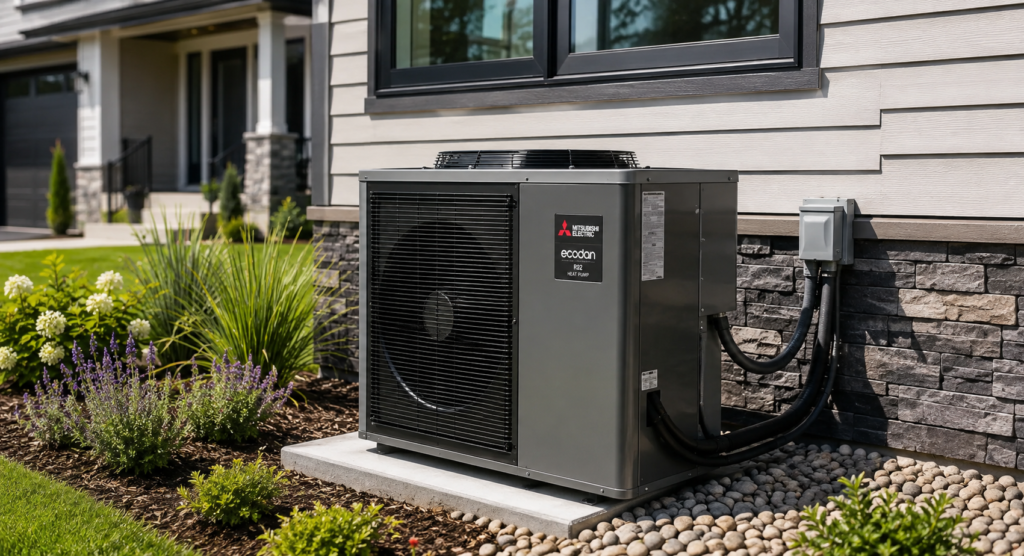
A homeowner in the Sunset called us last month with a straightforward question: her furnace was aging out, her contractor mentioned a heat pump as an option, and a friend in Ohio told her heat pumps “don’t really work once it gets cold.” She wanted to know if that applied to her house, three blocks from the ocean, in a neighborhood that sees fog more days than sun in July.
It’s a fair question, and it’s also the wrong comparison. Most of what people repeat about heat pumps and cold weather comes from places with hard winters. That is not what a heat pump has to deal with in San Francisco or Marin County.
What a Heat Pump Is Actually Doing
A furnace burns fuel or uses resistance heat to generate warmth. A heat pump does something different: it moves heat from one place to another, pulling warmth from outside air (even cold air still holds usable heat) and concentrating it indoors. In summer, it runs the process in reverse and works much like the equipment behind our own cooling services.
Because a heat pump is moving heat rather than generating it, it uses meaningfully less energy per degree of comfort than resistance heat or a standard furnace and AC combination in most conditions. The catch that gets repeated online is that older heat pump technology lost efficiency as outdoor temperatures dropped toward freezing and below, which is a real limitation in parts of the country that see single-digit winter temperatures.
San Francisco and Marin rarely see anything close to that. Winter lows in the city typically stay in the mid-40s, and even Marin’s colder inland pockets rarely drop below freezing for extended periods. Modern cold-climate heat pump models are commonly rated to maintain efficient output well below 0 degrees Fahrenheit, which puts the local climate well inside their comfort zone rather than at the edge of it.
The Real Local Variable Isn’t Cold. It’s the Fog and the Swing.
The more relevant local factor isn’t how cold it gets. It’s humidity and temperature swing. Coastal fog raises moisture levels, and homes close to the water can see meaningful temperature shifts between a foggy morning and a clear afternoon, sometimes within the same day. This is the same coastal moisture and swing we’ve written about before when explaining why older San Francisco homes lose heat, and it affects heat pump performance in similar ways.
A correctly sized heat pump handles this well, because it’s designed to modulate output rather than simply switching on and off at full blast. An incorrectly sized one, too large or too small for the space, is where problems actually show up locally: short cycling, uneven comfort between rooms, or a system that runs constantly without quite catching up. That’s a sizing and installation issue, not a climate limitation, and it’s the same failure mode that shows up with an incorrectly sized furnace or AC.
Why Ductless Mini-Splits Come Up So Often for Older SF and Marin Homes
A lot of the heat pump conversation locally is really a mini-split conversation. Many Victorians, Edwardians, and older Marin homes were never built with ducted forced-air systems, or have additions and converted spaces that ductwork never reached. Retrofitting full ductwork into a home with plaster walls and no existing chases is expensive and invasive.
A ductless mini-split heat pump sidesteps that problem. Each indoor unit heats and cools its own zone independently, connected to an outdoor compressor through a small conduit rather than a duct network. That makes it a practical fit for a top-floor addition that’s always too hot, a converted garage with no HVAC connection at all, or a home where preserving original plaster and trim matters more than running new ducts. For multi-level Marin homes in particular, this zone-by-zone approach works a lot like the room-by-room control we’ve covered in our guide to HVAC zoning systems for multi-level homes, just built around heat pump equipment instead of dampers on a shared duct system.
This isn’t the right fit for every layout. A home with functional existing ductwork in reasonable condition may get more value from a ducted heat pump system that uses that infrastructure, rather than several standalone indoor units, and that’s a conversation worth having with whoever handles your heating and cooling systems before deciding either way.
What Changed With Rebates in 2026
If you’ve researched heat pump costs any time in the last two years, some of what you read is now out of date. The federal 25C tax credit, which covered up to $2,000 for qualifying heat pump installations, expired at the end of 2025 and does not apply to systems installed in 2026. California’s HEEHRA program, an income-qualified rebate that offered some of the largest incentive amounts, hit its statewide funding cap for single-family homes earlier this year, and new applicants are currently limited to a waitlist rather than a guaranteed rebate.
That doesn’t mean incentives are gone. PG&E does not run one single flat heat pump rebate the way some municipal utilities do. Instead, it directs customers to a current incentive lookup tool that shows what’s actually available by ZIP code and household income at the time you check, since program funding and amounts shift throughout the year. Because these figures change, sometimes mid-year, the most reliable step is checking PG&E’s current program directly, or asking your contractor to confirm what applies to your specific address, before assuming a number you read somewhere still holds.
The practical takeaway for 2026: incentives are narrower and less automatic than they were a year or two ago, so a heat pump decision should be evaluated on its own energy and comfort merits first, with any current rebate treated as a bonus to confirm rather than the reason to move forward.
What to Ask Before You Switch
A few questions are worth raising with any contractor before committing to a heat pump or mini-split installation:
- Has a proper load calculation (often called a Manual J) been done for this specific home, rather than sizing based on the old system’s capacity?
- What are the unit’s SEER2 and HSPF2 ratings, and how do those compare to the system currently in place?
- Does this home need a single-zone or multi-zone system, and why?
- Is backup heat needed for the coldest nights, or is the proposed system rated to handle the home’s actual climate without one?
- Does the electrical panel have enough capacity, or is a panel upgrade part of this project?
What Not to Assume
Don’t size a system off an online calculator or a rule of thumb based on square footage alone. Older homes with single-pane windows, minimal insulation, or additions built at different times often don’t fit a generic formula, and an undersized or oversized system creates comfort and efficiency problems that show up for years. Don’t assume the lowest quote reflects the same scope of work as a higher one either; a proper load calculation and correct equipment sizing take real time, and a quote that skips that step is missing the part of the job that determines whether the system actually performs.
Repair, Replace, or Add a Heat Pump?
Not every aging furnace needs to be replaced with a heat pump system. If your existing heating services are still meeting the home’s needs and being properly maintained, a full swap may not be the most cost-effective move yet. In some cases, a mini-split addition to handle a specific problem room or addition makes more sense than replacing a whole-home system that’s still working. We believe in getting the most out of your existing equipment before recommending a replacement, and that applies to heat pump conversations as much as any other system decision.
If you’re deciding whether a heat pump or mini-split system makes sense for your specific home, whether that’s a full system replacement, a supplement for a problem room, or a look at whether your current setup is even a good candidate, a proper evaluation is the only way to answer it accurately. We’ll look at your actual home, your ductwork or lack of it, and your electrical capacity, and give you a straight answer.
Frequently Asked Questions
Do heat pumps work in San Francisco’s cold and fog?
Yes. San Francisco’s winter lows rarely approach the temperatures where older heat pump technology lost efficiency. Modern cold-climate heat pumps are rated well below the temperatures the Bay Area typically sees.
Is a ducted or ductless heat pump better for an older San Francisco or Marin home?
It depends on whether the home already has functional ductwork. Homes without existing ducts, or with additions ductwork never reached, are often better candidates for a ductless mini-split system.
What heat pump rebates are available in 2026?
The federal 25C tax credit expired at the end of 2025, and California’s HEEHRA program reached its funding cap for single-family homes. PG&E does not offer one flat rebate; available incentives should be checked directly through PG&E’s current program lookup, since amounts and eligibility change.
Do I need to replace ductwork to install a heat pump?
Not necessarily. A ducted heat pump can often use existing ductwork if it’s in good condition, while a ductless mini-split avoids the need for ducts entirely.
How do I know if my home needs a single-zone or multi-zone system?
That depends on the home’s layout and where comfort problems actually occur. A proper in-home evaluation, not a general rule, is the right way to determine this.