
The furnace in a lot of San Francisco and Marin homes barely runs from June through August. Then the first real storm of the season rolls through, the system finally has to work for a living, and a bedroom that felt fine all summer suddenly will not warm up past the mid-60s no matter where the thermostat is set. The instinct is to blame the furnace. Often, the furnace is fine. What actually changed is that the system is finally being tested hard enough, for long enough, to expose a problem that was already there.
Why This Shows Up the Moment the Rain Starts
In a lot of older San Francisco and Marin homes, ductwork was added years or decades after the house was originally built, often routed through a tight attic or crawlspace to reach a room that did not have forced-air heat to begin with. Those runs work fine when the furnace only kicks on for a few minutes at a time during a mild fall afternoon. Once the weather turns and the system runs for real, for hours at a stretch instead of minutes, any gap, disconnected joint, or crushed section in that ductwork gets exposed properly for the first time all year.
Cold, damp air surrounding the ducts makes the problem worse. A duct leak that barely mattered in October, when the attic air and the duct air were not that far apart in temperature, loses noticeably more heat per hour once the space around it turns cold and wet. According to ENERGY STAR, a typical home loses somewhere between 20 and 30 percent of the air moving through its duct system to leaks, holes, and poorly connected joints before that air ever reaches a room. Most of that loss happens quietly all year. It just becomes obvious the first week the system has to work hard.
What You Can Check Yourself
Before assuming anything about the furnace, a homeowner can usually narrow things down with a few observations:
- Is it always the same room? A bedroom or office that consistently runs cold while the rest of the house is comfortable points toward that specific duct branch rather than the system as a whole. A single room at the end of a long flexible duct run is a common candidate; a great room fed by its own dedicated duct usually is not.
- Does the thermostat reach its setting, just slowly, or does it never get there? A slow climb in one room suggests reduced airflow. A room that never reaches the set temperature at all, even after hours, suggests something closer to a full disconnection.
- Is airflow at that room’s vent noticeably weaker than at other vents? Standing near a supply register and comparing how much air is actually moving is one of the simplest checks available without any tools.
- Has the heating bill jumped more than it did during a similarly cold stretch last year? A meaningful, unexplained increase during comparable weather is worth noting, even though it is not proof on its own.
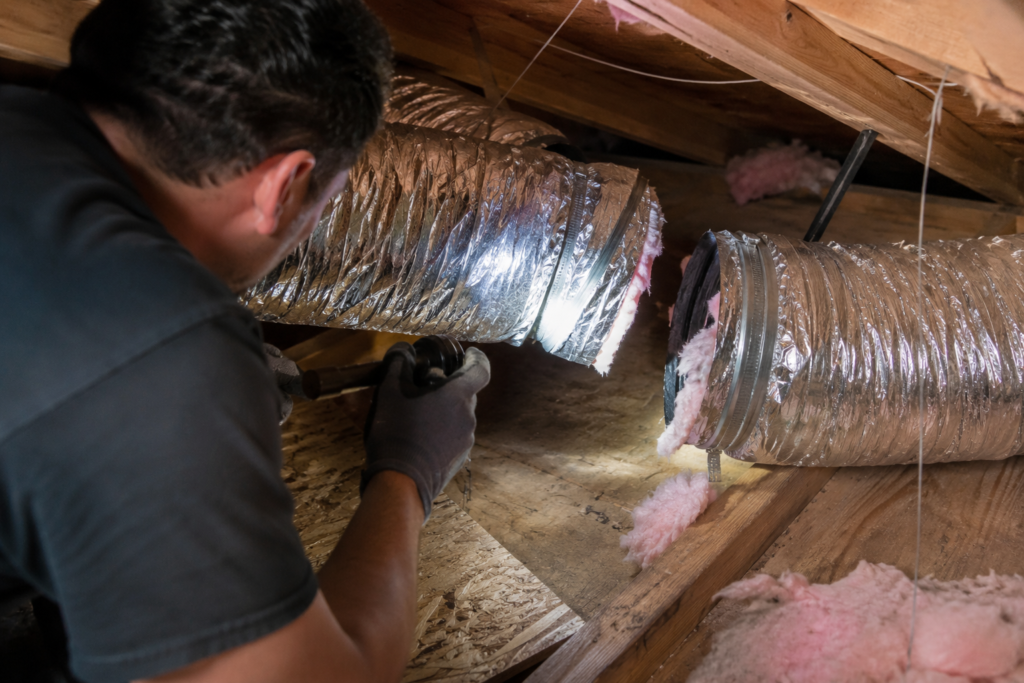
If ductwork is visible and safely accessible in an attic, basement, or crawlspace, a flashlight check can sometimes reveal an obvious problem: a disconnected joint, a section of flexible duct crushed by stored items, or insulation that has slipped away from a seam. Not every duct run is safely reachable, and this is a look, not a repair.
What Actually Requires Professional Testing
A visual check only catches the obvious problems. Confirming how much air is actually being lost, and where, takes equipment most homeowners do not have on hand. A static pressure test measures how hard the blower is working to push air through the system, which can indicate a restriction or leak even when nothing looks obviously wrong. A duct leakage test pressurizes the system and measures airflow loss directly, giving an actual percentage rather than a guess. Thermal imaging can trace heat loss along a duct run without opening every joint to look at it.
That testing also answers a question a homeowner usually cannot: whether the issue is duct leakage at all, or whether it is actually an envelope problem, meaning outside air is getting into the living space directly through a window, a gap around framing, or an attic hatch, rather than conditioned air escaping through the ducts before it arrives. Both problems can produce a cold room. They get fixed differently.
What an Inspection Actually Involves
A duct inspection is not one test but a short sequence of them. A technician typically starts with a visual walk of every accessible duct run, then takes a static pressure reading at the furnace itself, then checks airflow room by room at each register to see which ones are underperforming and by how much. Thermal imaging gets used selectively, mainly to confirm a suspected leak location without opening a joint that turns out to be fine. This is the same process behind Bay Air’s duct repair work: the findings point to a specific fix rather than a general recommendation. Sometimes it is one disconnected joint. Sometimes it is a longer run that needs to be resealed in a few places. It is rarely the whole system.
Duct Leak, Attic Moisture, or an Aging Furnace? How to Tell Them Apart
- One or two specific rooms underheating while the rest of the house is fine usually points to a duct or register issue on that particular branch, not a system-wide problem.
- The whole house taking longer than it should to warm evenly, but eventually getting there, points more toward insulation or building envelope issues than the ductwork itself.
- A furnace that short-cycles, makes unusual noise at the burner, or never reaches the set temperature anywhere in the house, not just in one room, points to the furnace itself. That is a separate issue, covered in “Why Your Furnace Short Cycles (Turns On and Off Frequently) – And How to Fix It” (link to the live post once the URL is confirmed).
What Not to Do
- Do not add attic insulation on top of a suspected duct leak before it is tested. Insulation on top of a leaking duct just insulates the leak; it does not stop the loss.
- Do not rely on standard cloth-backed duct tape to seal a duct, despite the name. ENERGY STAR specifically recommends against it, since the adhesive breaks down with the temperature swings ducts actually experience. Mastic sealant or metal tape rated for the purpose holds up over time.
- Do not climb through a tight attic or crawlspace alone chasing a suspected leak, particularly around insulation, electrical, or framing that may not be rated to support foot traffic. This is worth leaving to someone with the right equipment and experience, both for safety and for getting an accurate result.
Why This Comes Up More Often in Older San Francisco and Marin Homes
A lot of ductwork in this area was retrofitted into houses that were not originally designed for forced-air heat, run through additions, tight crawlspaces, or spaces shaped by decades of remodeling rather than a single clean install. This pattern turns up often in neighborhoods like Bernal Heights or the Sunset in San Francisco, and towns like Fairfax or San Rafael in Marin, similar to what’s described in “Why Do Older San Francisco Homes Lose Heat?” (link to the live post once the URL is confirmed): a house that started small has usually been added onto more than once. Coastal fog and seasonal rain add moisture that some of these older, patched-together runs were never built to handle particularly well, and wood-frame construction shifts slightly with the seasonal change in humidity, which can loosen a joint that was perfectly fine when it was installed.
The good news is that almost all of this is a repair, not a reason to replace anything. Sealing, reconnecting, or re-securing a section of ductwork is a fraction of the cost and disruption of a full system replacement, and it typically falls under routine ductwork and insulation services rather than anything bigger.
The Next Step
If a specific room in your home has never quite kept up once the rain sets in, a duct inspection can typically identify whether the cause is leakage, insulation, or the furnace itself within about an hour, and point to which of the three it actually is before any repair work begins. Bay Air runs this kind of inspection for homeowners across San Francisco and Marin County heading into the wetter months. Call (628) 289-3552 to schedule one.
Frequently Asked Questions
How can I tell if a cold room is a duct problem or a furnace problem?
If the rest of the house is comfortable and only one or two rooms are consistently cold, it usually points to the ductwork serving that specific area. If the furnace is struggling everywhere, or making unusual noise, or turning on and off more than it used to, that points to the furnace itself.
Is regular duct tape actually bad for sealing ducts?
Yes. Despite the name, standard cloth-backed duct tape loses its adhesion over time when exposed to the temperature swings inside a duct system. Mastic sealant or metal tape made for duct sealing holds up considerably longer.
How long does a duct inspection take?
A typical inspection, including a visual check, a pressure reading, and room-by-room airflow testing, usually takes about an hour, depending on how much of the ductwork is accessible.
Will adding insulation fix a duct leak?
No. Insulation added on top of a leaking duct traps the leak rather than stopping it. Leaks need to be sealed first; insulation is a separate step that helps once the duct itself is no longer losing air.
Why does this show up more in the rain than in summer?
Two things change at once: the furnace starts running far more often, which exposes weak points that barely mattered before, and the air around the ducts gets colder and wetter, which makes any existing leak lose more heat per hour.