
Heat Pump Blowing Cold Air or Steaming on Cold Mornings? How to Tell Defrost Mode From a Real Problem
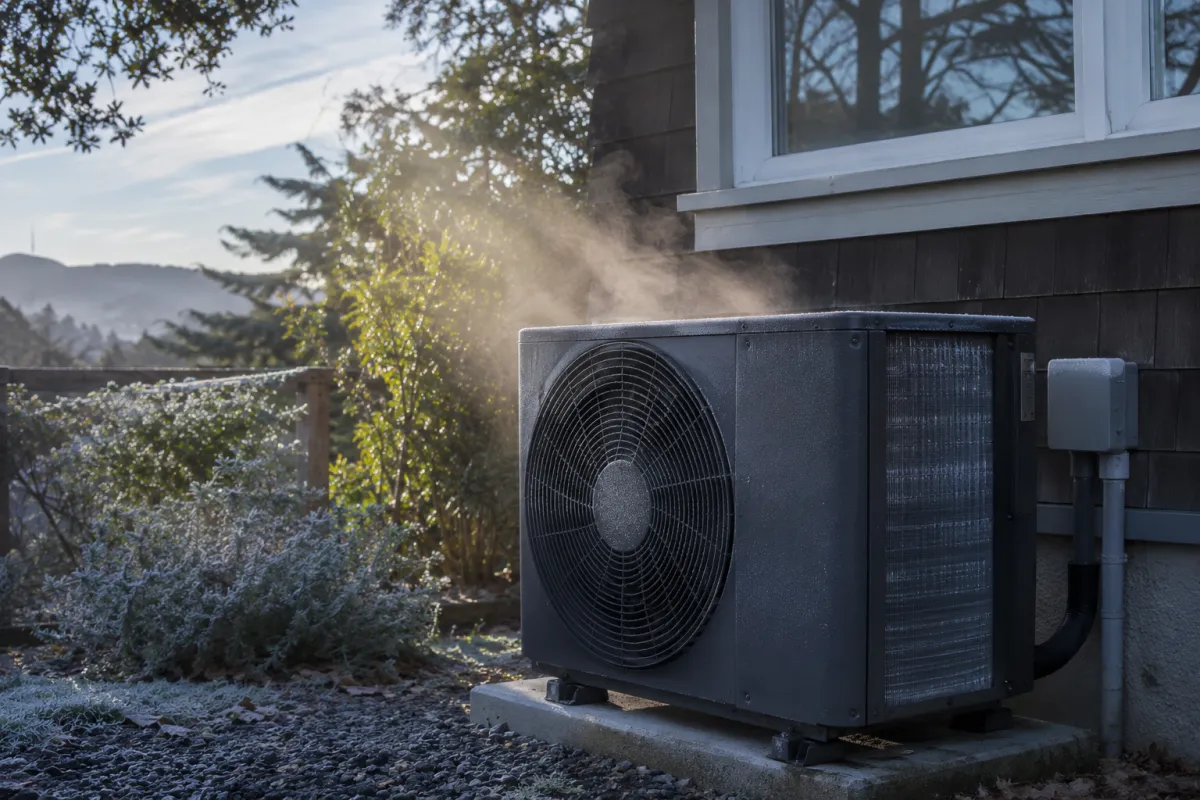
It’s 6:30 on a clear November morning. The heat pump has been running fine all week, and then the air from the vents suddenly feels lukewarm. You look outside and the outdoor unit is giving off a cloud of what looks like smoke. The fan has stopped. A minute later there’s a loud whoosh.
For most heat pumps, that sequence is normal. It’s called defrost mode, and it’s one of the most common reasons new heat pump owners think their system is failing. But a heat pump blowing cold air in winter can also point to a real problem, and the two can look similar for the first few minutes. Here’s how to tell them apart.
Why a Heat Pump Needs to Defrost
In heating mode, a heat pump pulls heat out of the outdoor air and moves it inside. To do that, the outdoor coil has to run colder than the air around it. On a cold, damp morning, that coil can drop below freezing even when the air temperature doesn’t, and moisture in the air freezes onto the fins as frost.
Frost acts like a blanket. It blocks airflow across the coil, so the system gets less and less heat out of the air. Defrost mode clears it. The heat pump briefly reverses direction, sending warm refrigerant to the outdoor coil to melt the frost, then switches back to heating.
That explains everything you see and hear during a normal cycle:
- Steam: melting frost hits cold air and turns to vapor. It often looks like smoke.
- The outdoor fan stops: the system is trying to warm the coil, not blow cold air across it.
- A whoosh or hiss: refrigerant is changing direction at the start and end of the cycle.
- Water under the unit: that’s the melted frost draining off.
- Cooler air indoors: while the system is defrosting, it isn’t heating the house the way it normally does.
Many systems finish a defrost cycle in roughly 5 to 15 minutes, though the timing and frequency depend on the manufacturer and the weather.
Why This Shows Up on Marin and San Francisco Mornings
You don’t need snow to frost a heat pump coil. Two very local conditions do it.
In inland Marin, places like Novato, San Rafael, Fairfax, and the Ross Valley often get clear, still winter mornings that drop near or below freezing. Those are textbook defrost conditions, and homeowners who switched from a gas furnace often notice them for the first time.
Closer to the coast, freezing temperatures are less common, but the air carries a lot of moisture. On a cold, damp morning, a coil running below the outdoor temperature can still collect frost, so occasional defrost cycles aren’t unusual there either.
Coastal conditions can also make defrost happen more often than it should. Salt air can corrode the thin aluminum fins on an outdoor coil, and dirt, leaves, or a crowded side yard can restrict airflow. A coil that can’t breathe frosts faster.
Why Heat Pump Air Feels Cooler Than Furnace Air (Even When Nothing Is Wrong)
If you recently replaced a gas furnace with a heat pump, the air may feel cooler than you’re used to all the time, not just during defrost. That’s normal. A furnace delivers short bursts of very hot air. A heat pump usually delivers a steadier flow of warm air, often somewhere in the 90s, that can feel cool against your hand because it isn’t much warmer than your body, and we expect "heat" to feel hotter than that.
The better test is whether the house reaches and holds the temperature you set. If it does, the system is probably doing its job even if the air at the register feels mild.
Ducted Systems vs. Mini-Splits: What Defrost Looks Like Indoors
What you notice inside depends on the type of system.
Ducted heat pumps sometimes have backup heat, usually electric heat strips in the indoor air handler. Some systems turn that backup on during defrost so the air from the vents stays warm. Others don’t, so you feel cooler air for a few minutes. Your thermostat may show "aux" or "auxiliary heat" while the backup is running.
Ductless mini-splits typically handle defrost differently. On many models, the indoor fan slows or stops during defrost so it doesn’t blow cool air into the room, and a light on the indoor unit may blink. It’s easy to mistake that for the unit shutting off. Your owner’s manual usually explains what that light means for your specific model.
Normal Defrost vs. Signs of a Problem
The most useful thing you can do is watch one full cycle. A normal defrost has a beginning and an end. Problems usually don’t.
| What you notice | Usually normal | Worth having checked |
|---|---|---|
| Steam from the outdoor unit | Lasts a few minutes, then stops | Continues for a long time, or comes back every few minutes |
| Frost on the coil | Light, even frost that clears after a cycle | Thick ice that stays, or ice building up on the top or around the base |
| Outdoor fan | Stops during defrost, restarts afterward | Never runs, or never stops |
| Indoor air | Cooler for a few minutes, then warm again | Stays cool, and the house keeps losing temperature |
| Thermostat | "Aux" shows briefly during defrost or a big temperature jump | "Aux" is on almost all the time, often with higher electric bills |
| Sounds | A whoosh at the start and end of the cycle | Grinding, loud buzzing, or repeated clicking with no restart |
| Smell | None, or a brief dusty smell the first time backup heat runs each season | A burning plastic or electrical smell, or visible smoke that isn’t steam |
If you see smoke that isn’t steam or smell something electrical, turn the system off at the thermostat and call for service. Don’t wait to see if it clears.
What Can Cause Defrost Problems
Symptoms alone can’t tell you which of these is going on. That takes testing, but it helps to know the range of possibilities:
- Airflow problems outdoors: a dirty or corroded coil, plants or stored items too close to the unit, or a failing outdoor fan motor.
- Airflow problems indoors: a clogged filter or closed registers can make the whole system run harder and colder.
- Low refrigerant: a system that’s short on refrigerant has a leak somewhere, and it often frosts unevenly and heats poorly.
- Defrost controls: a failed defrost sensor or control board can keep the unit from entering defrost, or keep it from leaving.
- Reversing valve: the part that switches the system between heating and defrost can stick.
- Water refreezing on the unit: a gutter or roof edge dripping onto the outdoor unit can refreeze into ice that defrost can’t keep up with.
- Thermostat setup: a thermostat that isn’t configured for a heat pump, or large overnight setbacks, can cause the backup heat to run far more than it should.
That last point catches a lot of people this time of year. A deep overnight setback followed by a big jump in the morning is a common way to trigger backup heat. We covered how night settings differ for heat pumps and furnaces in our post on resetting your thermostat after the clocks fall back.
What a Technician Checks
When we diagnose a heat pump that isn’t heating well in cold weather, we typically look at:
- How the coil frosts and whether a defrost cycle actually starts and finishes
- Refrigerant pressures and temperatures in heating mode
- The defrost sensor, defrost control, and reversing valve operation
- Outdoor and indoor fan operation and airflow
- The temperature rise across the indoor unit, with and without backup heat
- Thermostat type, wiring, and heat pump settings
- Coil condition, corrosion, drainage, and clearance around the outdoor unit
What Not to Do
- Don’t chip, scrape, or hose off ice. The fins and refrigerant tubing are easy to damage, and a puncture turns a minor problem into a major one.
- Don’t open the outdoor unit or the indoor air handler. Both have high-voltage components inside.
- Don’t cover the unit with a tarp or box to keep frost off. It needs open airflow to work.
- Don’t leave the thermostat on "emergency heat" as a fix. Emergency heat runs only the backup heat, which can cost much more to operate. Use it only if the heat pump has actually stopped heating while you wait for service.
What you can safely do: keep a couple of feet clear around the outdoor unit, check and replace the indoor filter, make sure registers and returns aren’t blocked, and notice whether a gutter or roof edge drips onto the unit.
When to Have Your Heat Pump Looked At
If your heat pump goes through a cycle like the one described above and returns to steady heat, you can usually leave it alone. If the ice stays, the house keeps getting colder, the backup heat runs most of the time, or something smells or sounds wrong, it’s time for a diagnosis.
Bay Air services heat pumps and ductless mini-splits throughout San Francisco and Marin County. If yours isn’t behaving the way this post describes, tell us what you’re seeing or call (628) 289-3552. A good description of when it happens and how long it lasts helps us diagnose it faster. For more on keeping your home heated this season, visit our heating services page.