
Is Your Furnace Closet Doubling as a Storage Closet? What's Safe to Keep There and What Isn't
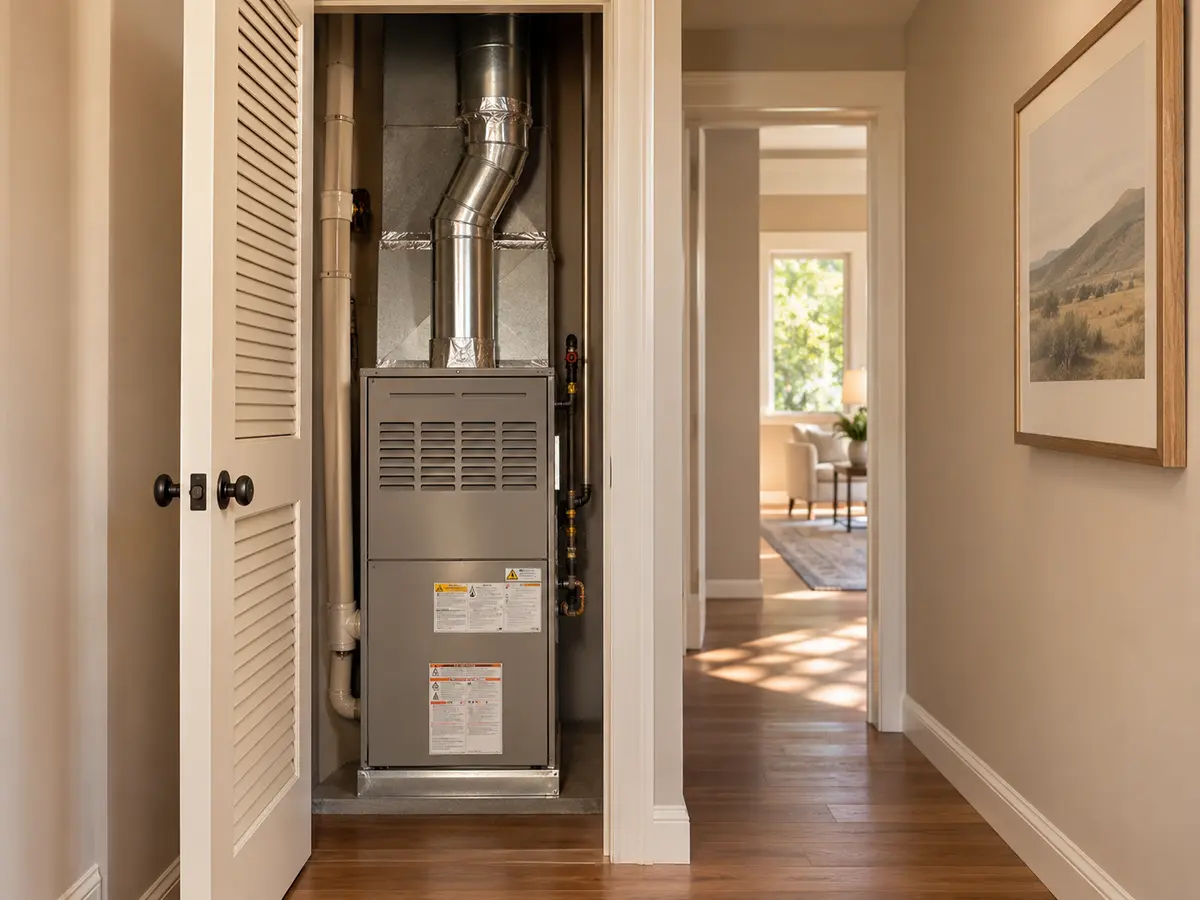
In a lot of San Francisco and Marin homes, the furnace lives in a hallway closet, under the stairs, or in a corner of the garage. Closet space is scarce, so that spot slowly fills up. The vacuum goes in first. Then a mop bucket, a case of paper towels, the holiday decorations, and the paint left over from the last touch-up.
It feels harmless because the furnace has been fine so far. But a furnace closet does more than hide equipment, and storage can interfere with all of it.
The short answer: a furnace closet shouldn’t be used as general storage. Anything that can burn needs to stay outside the furnace’s required clearances. Nothing should block the service panel, the filter, the vent pipe, or any louvers or air openings. Flammable liquids and household chemicals shouldn’t be stored in the same space as a gas furnace at all. The exact clearances depend on your furnace’s label and installation instructions, so the right distances vary from one unit to the next.
What a furnace closet is actually doing
That closet has three jobs, and storage can interfere with each one.
- Keeping heat away from things that burn. Every furnace is listed with minimum clearances to combustible materials. Those distances assume the space around the furnace stays clear.
- Supplying air for combustion. Many gas furnaces burn air from the room they sit in. In a closet, that room is small, so the closet is designed to pull air in from the rest of the house through louvers or vents.
- Giving access for service. Technicians need room to reach the burners, controls, and venting. You need to reach the filter.
Problem 1: Things that burn end up too close to hot surfaces
Your furnace’s clearance requirements are printed on a label on the cabinet and in the installation manual. The metal vent pipe that carries exhaust out of the house also gets hot. Single-wall metal vent pipe commonly needs around 6 inches of space from anything combustible, though your system’s listing is what counts.
Here’s the catch. A furnace can be installed with perfect clearances, and then storage erases them over time. A box slides against the cabinet. A shelf gets added above. Linens get stacked on top of the unit because it’s flat and warm.
For household purposes, the National Fire Protection Association recommends keeping anything that can burn at least three feet from heating equipment, including furnaces. That’s a sensible rule for a home, even if your furnace’s label allows less.
Problem 2: The furnace may be running short on air
This is the part most homeowners don’t know about.
The fuel gas codes use a simple benchmark: a space with gas appliances needs at least 50 cubic feet of volume for every 1,000 BTU per hour of combined appliance input. Below that, the space is considered “confined” and needs dedicated openings to bring in more air.
For perspective, a 60,000 BTU furnace would need about 3,000 cubic feet of connected space. A closet that’s 3 feet by 3 feet by 8 feet holds 72. That’s why many closet furnaces have a louvered door or grilles near the top and bottom of the closet. Those openings were sized to keep the furnace supplied. If a gas water heater shares the closet, its input counts too, which raises the requirement.
Now picture boxes stacked against the louvers, or a solid door installed during a remodel because it looked cleaner or blocked noise. The furnace can end up short on air. That can lead to poor combustion, safety switches shutting the furnace down, and in the worst cases, exhaust gases spilling back into the home, including carbon monoxide.
Problem 3: What’s stored there can damage the furnace
Furnace manufacturers warn against installing furnaces where combustion air is contaminated by chemicals like chlorine and fluoride compounds. Those show up in bleach, laundry detergent, aerosol sprays, cleaning solvents, air fresheners, and pool chemicals. When those vapors get pulled into the burner, they form acids that can corrode the heat exchanger and venting over time.
In other words, a furnace closet that doubles as a cleaning-supply closet is a setup installation manuals specifically caution against.
Flammable liquids are a more immediate concern. Gasoline, paint thinner, solvents, and some aerosols give off vapors you can’t see. The U.S. Consumer Product Safety Commission warns never to store gasoline near pilot lights, furnaces, or other ignition sources.
Problem 4: Nobody can reach anything
When the filter slot is buried behind a stack of boxes, the filter doesn’t get changed. When the service panel is blocked, maintenance takes longer and small issues like rust, soot, or a loose vent connection are easier to miss.
A quick way to tell how your furnace gets its air
You don’t need to open anything to learn a lot about your system. Look at the pipes coming off the top or side of the furnace.
- One metal vent pipe heading up usually means a standard-efficiency furnace that burns air from the space around it. The closet’s air supply matters a great deal for this type.
- Two white plastic PVC pipes running outside usually means a high-efficiency, sealed-combustion furnace that brings in outdoor air for burning and sends exhaust back out.
There are exceptions. Some high-efficiency furnaces use a single plastic pipe and still draw combustion air from the room. And no furnace type gets a pass on clearances, access, or flammable storage. A sealed-combustion furnace is simply less affected by a crowded closet’s air supply.
What to keep out of the furnace closet
- Gasoline, paint thinner, solvents, oil-based paints and stains
- Aerosol cans of any kind
- Bleach, laundry detergent, chlorinated cleaners, pool chemicals
- Cardboard boxes, paper goods, wrapping paper, holiday decorations
- Clothing, linens, and anything stacked on top of the furnace
- Anything leaning on or touching the vent pipe
If space is genuinely tight, keep anything you do store in that closet to a few nonflammable items, outside the clearance and working space, and never in front of louvers, the filter, or the service panel. Ask your technician whether your closet has room for that at all.
Why this comes up so often in San Francisco and Marin
Local housing makes the furnace closet a natural target for storage. In older San Francisco homes, furnaces often sit in narrow hallway closets or in ground-floor garages that also hold bikes, tools, and paint. In Marin, remodels and additions sometimes reframe a closet around existing equipment or replace a louvered door with a solid one for appearance or quiet.
Garages deserve a specific note. Gas appliances in garages are typically installed with their burners raised off the floor, often 18 inches, because fuel vapors are heavy and settle low. That requirement reduces risk. It doesn’t make it safe to keep gas cans or paint thinner beside the furnace.
A 5-minute furnace closet check
- Find the clearance label on the furnace cabinet or in the manual. If it’s behind a panel, leave that for your technician.
- Clear the front of the furnace so the filter and service panel are easy to reach.
- Make sure nothing is resting on the furnace or touching the vent pipe.
- Check that louvers or grilles are open and unobstructed, and that the closet door hasn’t been swapped for a solid one.
- Move paint, fuel, aerosols, and cleaning chemicals somewhere else entirely.
- Confirm you have a working carbon monoxide alarm. California requires them in homes with fuel-burning appliances.
- Look for warning signs: soot or scorch marks near the furnace, a rusty vent pipe, or a furnace that keeps shutting itself off.
What not to do
- Don’t cover louvers or add weatherstripping to the closet door to cut noise or drafts.
- Don’t build shelves above or around the furnace without confirming the clearances first.
- Don’t open burner or electrical compartments, and never bypass a safety switch on a furnace that keeps shutting off. Repeated shutdowns are a symptom worth diagnosing, not a nuisance to override.
When it’s worth having a technician look
Some things can be seen from the doorway. Others require testing. A technician can compare actual clearances to your furnace’s listing, confirm the closet’s air openings are sized for every gas appliance in the space, inspect the vent connection, and test draft and combustion.
It’s worth scheduling a look if:
- Your furnace keeps shutting off or restarting
- You see soot, scorching, or corrosion around the furnace or vent pipe
- A furnace and a gas water heater share one small closet
- You’re remodeling around the mechanical closet
- You’re replacing a furnace in an existing closet. A newer unit may have different clearance or venting requirements than the one it replaces.
Helpful questions to ask: Does this closet meet the air requirement for all the appliances in it? Is anything stored here that you’d move? If I replace the furnace, will the new one fit with its required clearances?
If your carbon monoxide alarm sounds, don’t troubleshoot. Get everyone outside and call 911 or PG&E from outside the home.
A clear closet is an easy fix
Most of what’s in this article costs nothing to fix. It’s a matter of moving a few things and keeping the space clear going forward.
If your furnace closet has been pulling double duty and you’re not sure what your system needs around it, Bay Air can check clearances, air supply, and venting during a furnace maintenance visit in San Francisco or Marin County. Call (628) 289-3552 or request a visit online.