If you’ve ever closed every window during a smoky week and still noticed a faint burnt smell inside by the second day, you already know the uncomfortable truth: closing windows helps, but it isn’t the whole answer. Homes leak air. Doors get opened. Bathroom fans pull outside air in to replace what they exhaust. And once smoke particles get inside, your HVAC system becomes either the thing that helps clear them out or the thing that keeps recirculating them through the house.
The Bay Area Air District’s most recent wildfire safety advisory, issued in June 2026, flagged this year’s wildfire potential across Northern California as near to above normal for much of the summer, driven by dry fuels and developing drought conditions. That’s a good reason to figure out where your system actually stands before a Spare the Air alert shows up on your phone, rather than during one.
What Your HVAC System Can Actually Do About Smoke
A central heating and cooling system doesn’t create clean air on its own. What it does is move air through a filter, over and over, as it heats or cools your home. The filter is doing the actual work. If that filter isn’t rated to catch fine particulate matter, smoke passes right through it and keeps circulating.
Wildfire smoke is mostly made up of PM2.5, particles small enough to get deep into your lungs and too small for a basic filter to stop. A standard fiberglass filter, the kind that mainly protects the equipment from dust and debris, does very little against smoke. To meaningfully reduce PM2.5 indoors, most HVAC professionals and the Air District point to MERV 13 or higher filtration.
Here’s the part that gets left out of most general smoke-prep advice: not every system can safely run a MERV 13 filter. Higher MERV ratings are denser and create more resistance to airflow. Older blower motors, undersized ductwork, or systems that were already working near their limit can struggle to pull air through a high MERV filter. The result isn’t just weaker filtration. It can mean reduced airflow to certain rooms, a system that runs longer to reach the same temperature, or in some cases added strain on the blower motor over time.
This is why the honest answer to “should I just put in a MERV 13 filter” is “it depends on what your system can actually handle,” not a blanket yes. If you’re not sure what your current filter is rated for, our MERV rating guide breaks down what each rating actually filters out, and our indoor air quality services page covers the filtration and purification options available for homes in San Francisco and Marin County.
What a Homeowner Can Check, and What Requires a Technician
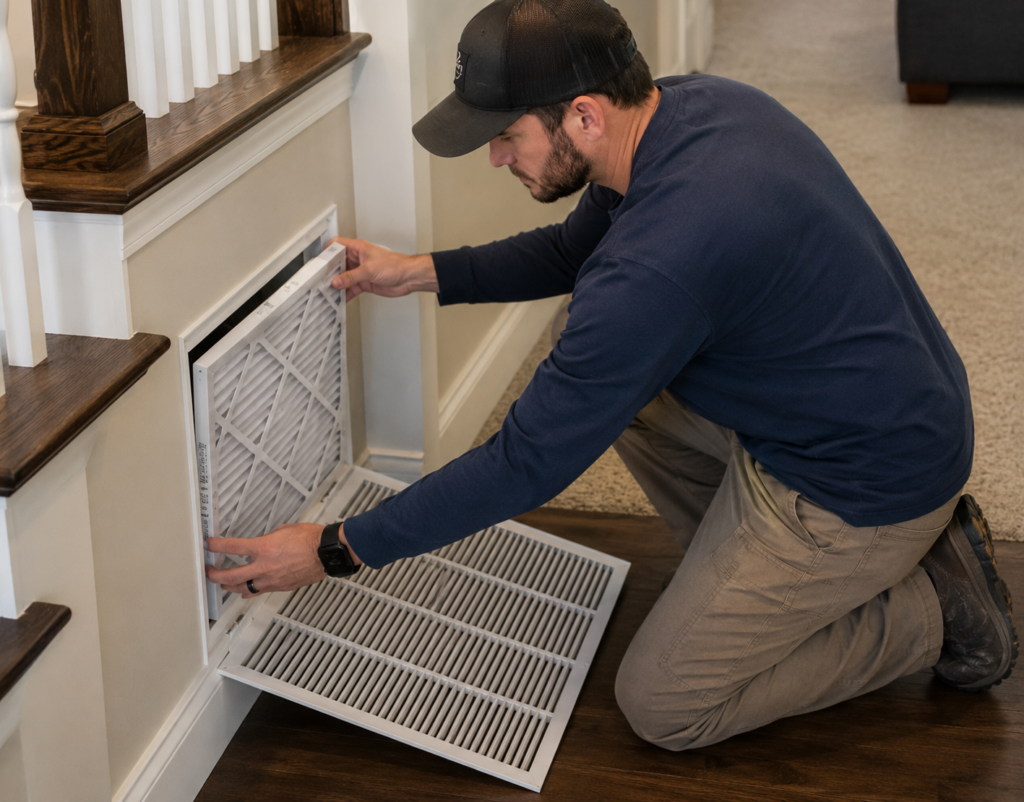
There are a few things you can reasonably check yourself:
- The filter slot size and the MERV rating printed on your current filter
- Whether your thermostat has a “recirculate” or “fan on” setting separate from heating and cooling
- Whether you can see or smell any gap around doors, windows, or the attic hatch when it’s smoky outside
What you generally can’t assess on your own is whether your specific blower motor and duct sizing can handle a jump to MERV 13 without a meaningful drop in airflow. That’s a static pressure question, and it’s something a technician measures rather than something you can eyeball. If your system is older or was already running loud or working hard on hot days before smoke was even part of the equation, that’s a reasonable signal to get it checked rather than assuming a filter swap alone will solve the problem.
The Recirculate Setting Matters More Than People Realize
Many homeowners don’t realize their thermostat has a fan setting that’s separate from the heating or cooling cycle. Running the fan on “on” instead of “auto” during a smoke event keeps air moving continuously through the filter, rather than only when the system is actively heating or cooling. Combined with an appropriately rated filter, this is one of the more effective things a homeowner can do without any equipment changes at all.
The tradeoff is energy use and, again, whether the system is suited to running continuously. This is worth confirming rather than assuming, especially in older equipment.
Portable Air Purifiers Versus HVAC Filtration
A portable HEPA air purifier and a whole-home HVAC filter upgrade solve different problems, and they’re not interchangeable.
A portable purifier cleans the air in the specific room it’s in, continuously, regardless of whether your HVAC system is running. It’s a reasonable option for a bedroom or a room where someone spends most of their time, and it doesn’t depend on your duct system’s condition at all.
An upgraded HVAC filter, when your system can support it, cleans air throughout the whole house every time the system cycles, but only while it’s running, and only as well as your ductwork allows. If your ducts have leaks or gaps, which is a real possibility in older San Francisco and Marin homes with original or aging duct runs, some of that filtered air can be diluted with unfiltered air pulled in through those gaps before it ever reaches a room.
For many homes, the most effective approach during a heavy smoke event combines both: an appropriately rated HVAC filter running on recirculate, plus a portable purifier in the room where it matters most, like a bedroom or a home office. Our air filtration systems page has more detail on how whole-home filtration and standalone purifiers fit together.
What Not to Do During a Smoke Event
- Don’t rely on a cheap fiberglass filter and assume it’s helping. It isn’t doing meaningful work against smoke particles.
- Don’t run bathroom or kitchen exhaust fans more than necessary. They pull air, and whatever is outside, into the house to replace what they vent out.
- Don’t assume a MERV 13 filter is automatically safe for your system. Confirm it first.
- Don’t wait until the air quality index is already unhealthy to check your filter and settings. By then you’re troubleshooting instead of preparing.
A Few Signs Worth Having Looked At
If any of the following sound familiar, it’s worth having a technician take a look before the next smoke event rather than during one:
- Your system already runs longer than it used to just to reach the set temperature
- One or two rooms have always run warmer or colder than the rest of the house
- You’ve never had your ductwork inspected for leaks or gaps
- You’re not sure what MERV rating your current filter is rated for
None of these are emergencies on their own. They’re the kind of thing that’s easy to ignore in mild weather and inconvenient to discover for the first time during a smoke advisory. On days when you’re not sure how bad conditions actually are outside, the EPA’s Fire and Smoke Map is a useful way to check real time smoke and air quality data for your specific area before deciding how to run your system.
The Bottom Line
Wildfire smoke season doesn’t require an entirely new HVAC system to manage well. In most cases it comes down to three things: whether your filter is actually rated for fine particulate matter, whether your system can handle that filter without a meaningful airflow penalty, and whether you’re using the recirculate setting when it counts. Getting clear answers to those three questions now, while the air is clear, is a lot more useful than guessing during the next Spare the Air alert.
If you’re not sure where your system stands on any of that, a straightforward filtration and airflow check can answer it before smoke season is in full swing. We work with homeowners throughout San Francisco and Marin County on exactly this kind of evaluation.
Frequently Asked Questions
Can my air conditioner filter out wildfire smoke on its own? Only if the filter installed is rated to catch fine particulate matter, generally MERV 13 or higher. A standard fiberglass filter provides very little protection against smoke.
Will a MERV 13 filter work in my existing system? Not always. Higher MERV filters restrict airflow more than standard filters, and some older or undersized systems aren’t built to handle that restriction without a performance tradeoff. It’s worth confirming before making the switch.
Should I turn my HVAC fan on during a smoke event? Setting the thermostat fan to “on” instead of “auto” keeps air moving continuously through the filter, which can meaningfully improve filtration during a smoke event, as long as the system is suited to running continuously.
Is a portable air purifier better than upgrading my HVAC filter? They do different jobs. A portable purifier cleans one room continuously. An upgraded HVAC filter can address the whole home, but only while the system runs and only as well as the ductwork allows. Many homes benefit from using both.
How do I know if my ductwork is letting unfiltered air in? This generally requires a professional inspection. Signs that make it worth checking include uneven temperatures between rooms, a system that runs longer than it used to, or ductwork that has never been inspected.