A property manager gets a service report saying the building’s rooftop unit “runs on a phased-out refrigerant.” A week later, a replacement proposal arrives. The implied message is that the equipment is on borrowed time and the owner should act now.
Usually, that’s not the whole story. Existing R-410A equipment is not illegal to operate, and it can still be repaired and recharged. What has changed is the rules for new equipment, and in California those rules don’t line up neatly with the national headlines. If you own or manage a commercial building in San Francisco or Marin County, here’s what the R-410A phase out actually means for your equipment and your budget. You’ll also find the questions worth asking before you sign anything, whether the work comes from us or from another contractor you’re considering for commercial HVAC services in San Francisco and Marin.
The short answer: your existing equipment is not banned
R-410A has been the standard refrigerant in commercial split systems, packaged rooftop units, and VRF systems for roughly two decades. It’s being phased down because of its high global warming potential (GWP), a measure of how much heat a gas traps compared with carbon dioxide. R-410A rates about 2,088. The replacements now showing up in new equipment, mainly R-454B and R-32, rate roughly 466 and 675.
The phase down targets refrigerant production and new equipment. It does not require you to remove, retrofit, or replace a working R-410A system. EPA’s rules restrict the installation of new systems, and components used to repair existing systems are not subject to those restrictions. Service refrigerant also remains legal to buy and use for existing equipment.
What will change over time is cost. Federal law keeps shrinking the supply of newly produced HFC refrigerants, and the industry broadly expects R-410A to get more expensive as that happens. That matters far more for a system that leaks than for one that holds its charge.
What changed at the federal level in 2026
The federal rules have shifted enough that many articles online are out of date. Here’s the current picture:
- Manufacturing and import of new residential and light commercial split AC and heat pump systems using R-410A stopped at the start of 2025.
- The original federal rule made January 1, 2026 the last day to install that leftover inventory. In May 2026, EPA finalized a revision, effective July 27, 2026. It removed the installation deadline for qualifying split-system equipment manufactured or imported before 2025.
- That relief applies to split systems. Packaged equipment and VRF systems follow separate schedules. At the federal level, R-410A VRF systems made before 2026 can be installed only until January 1, 2027, and the May revision didn’t change that date.
For the current federal requirements by equipment type, EPA’s Technology Transitions sector table is the most reliable reference. If you’ve read that “the R-410A deadline was canceled,” that’s true for one category of equipment, and only at the federal level.
Why California owners shouldn’t rely on national headlines
California has its own HFC regulation, administered by the California Air Resources Board (CARB). It sets refrigerant limits for new air-conditioning equipment independently of EPA, and California’s rules have generally been the stricter of the two. Under CARB’s regulation, new AC equipment has been held to refrigerants below 750 GWP since 2025, and new VRF systems since 2026.
The practical takeaway: a federal change doesn’t automatically loosen what can be installed in a San Francisco or Marin building. Someone may offer to install new R-410A equipment, such as discounted leftover inventory or a “like-for-like” swap. If so, ask them to confirm in writing that the installation complies with both federal and California rules. A contractor working in California should be able to answer that clearly.
California also runs a Refrigerant Management Program for larger existing systems, which includes leak inspection and recordkeeping requirements. If your building has large rooftop units, a central plant, or multi-zone VRF, find out whether any of your systems fall into that category.
Rooftop units, split systems, and VRF are different questions
Commercial buildings in San Francisco and Marin usually have a mix of equipment, and each type raises a different planning question.
Packaged rooftop units. These are common on low-rise retail, restaurants, medical offices, and flex space. When a rooftop unit fails, the replacement also involves curb adapters, crane access, and, in dense parts of the city, street-use logistics. Those factors often affect cost and scheduling more than the refrigerant does.
Split systems. These are common in smaller offices, storefronts, and older mixed-use buildings, where the condensing unit sits on a roof, in a light well, or in a rear yard. A failed R-410A outdoor unit can’t simply be paired with a new A2L outdoor unit while the old indoor coil stays in place, because both sides have to match the refrigerant. A “partial” replacement is often bigger than it first looks.
VRF systems. These are increasingly popular in renovated older buildings because they move heat through small refrigerant lines instead of large ducts. That suits tight ceilings and historic structures. VRF systems also carry larger refrigerant charges routed through occupied spaces, so the move to A2L refrigerants adds more design considerations here than anywhere else. If you’re planning a VRF project, confirm early which refrigerant the proposed equipment uses and what that means for your floor plan.
What R-410A really means for your operating costs
The real financial question isn’t “Is my refrigerant being phased out?” It’s “How much refrigerant is my system losing?”
A tight system that holds its charge can go years without needing refrigerant. A system that needs a top-off every season is leaking somewhere: a rubbed line set, a corroded coil, a failing valve core, a cracked joint. As R-410A prices rise, that recurring top-off costs more each year, and the leak itself usually gets worse. A system running low on refrigerant also loses capacity and efficiency long before it stops cooling, which we explain in more detail in how refrigerant charge affects performance.
This is where local conditions come in. Salt air and fog speed up corrosion on outdoor coils and exposed copper, especially on rooftops near the water. A building in the Marina District, or one we service for HVAC in Marin County near Sausalito, may develop coil leaks earlier in a system’s life than an identical unit a few miles inland. Factor that into replacement planning, including whether new equipment should have coated coils.
When repair still makes sense
For many buildings, keeping a working R-410A system in service is still the sensible choice. Repair deserves serious consideration when:
- The system holds its charge and has no recurring leak history.
- The failure is a common, contained repair, such as a capacitor, contactor, fan motor, or control board.
- The equipment is mid-life and has been maintained.
- Replacing it would require major structural, electrical, or crane work you’d rather schedule deliberately than in an emergency.
If a leak is the problem, locating and fixing it through commercial HVAC repair is usually the first step before any replacement discussion. Catching coil corrosion and slow leaks early is also one of the most practical reasons to keep planned maintenance for rooftop units on the calendar.
When replacement planning deserves a closer look
Replacement is worth planning, not rushing, when:
- The system needs refrigerant repeatedly, especially when the leak is in the coil.
- The compressor has failed on an older unit, since that repair can approach a meaningful share of replacement cost.
- Several units on the same roof are near the end of their service life and could be replaced together, which can reduce crane and permitting costs per unit.
- Tenants have comfort problems the current system can’t solve, whether from undersizing, poor zoning, or a change in how the space is used.
The goal is commercial HVAC replacement on your schedule, with time to compare options, rather than during a breakdown with tenants calling.
What A2L equipment changes about a replacement
A2L is a safety classification under ASHRAE Standard 34. The “A” means lower toxicity. The “2L” means lower flammability with a slow burning velocity. These refrigerants are very different from highly flammable ones like propane, but they are handled differently from R-410A. New A2L equipment commonly includes refrigerant leak detection, and the work requires A2L-rated tools and trained technicians.
In a commercial building, that can mean:
- Leak detection and mitigation controls that must be wired and commissioned, not just installed.
- Closer review of where indoor units and refrigerant lines sit, particularly in small rooms, closets, and ceiling spaces common in older buildings we see across HVAC service in San Francisco.
- Separate labeling and records if your building will run R-410A and A2L equipment side by side for years, as most mixed portfolios will.
None of this is a reason to avoid A2L equipment. It’s a reason to make sure whoever quotes the job has actually planned for it.
Questions to ask before approving refrigerant work or a replacement
- Which refrigerant does each of our systems use, and roughly how much charge does each hold?
- Is refrigerant being added because of a confirmed leak, and has the leak been located?
- If we repair the leak, what’s the realistic outlook for this coil or line set?
- For any R-410A equipment you’re proposing, can you confirm it complies with both federal and California rules?
- For A2L equipment, what leak detection and controls are included, and who commissions them?
- Can we replace units in a planned sequence instead of all at once?
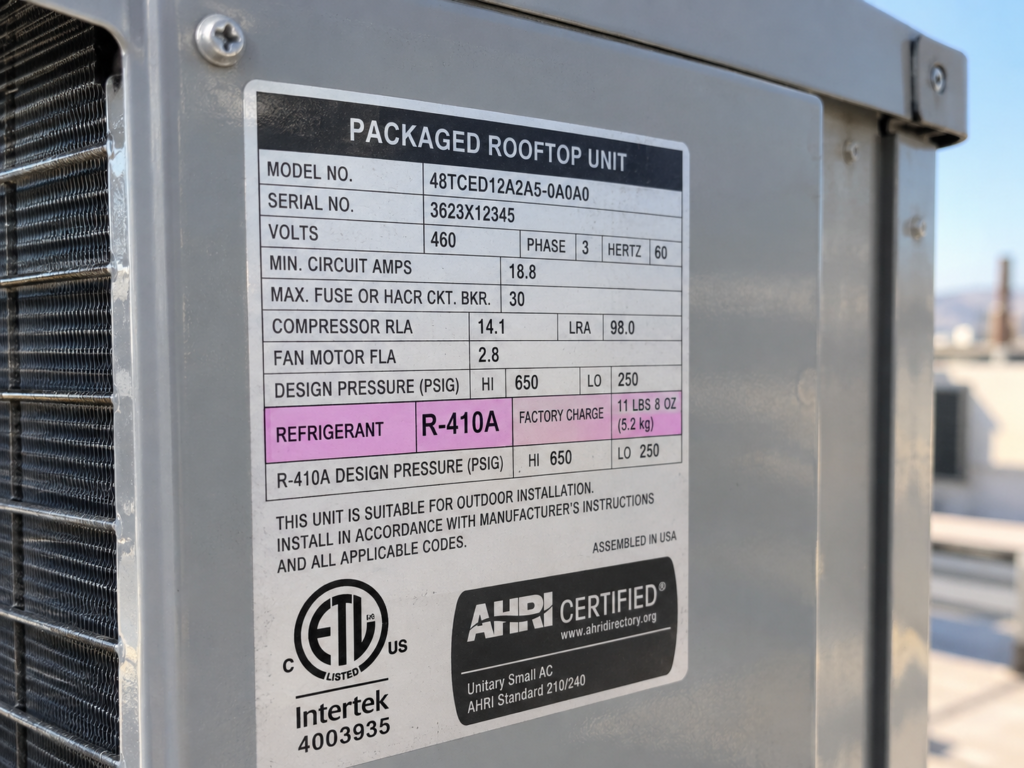
If you own or manage a building in San Francisco or Marin County, start with a simple equipment inventory. For each unit, list the refrigerant type, approximate age, charge size, and leak or repair history. Most of that is on the equipment nameplates and in past service invoices.
With that list in hand, the R-410A question becomes a planning exercise instead of a surprise. Bay Air Heating & Cooling can survey your rooftop and mechanical spaces, document what you have, and give you an honest read on which systems are worth maintaining and which belong in next year’s budget.
What not to do
- Don’t approve repeated refrigerant top-offs without a leak search. Adding refrigerant to a leaking system treats the symptom, and you’ll pay for the same leak again next season.
- Don’t assume a newer refrigerant can go into an existing R-410A system. Refrigerants aren’t interchangeable, and mixing them can damage equipment and void warranties.
- Don’t buy surplus R-410A equipment online and ask a contractor to install it. Beyond the compliance questions, you lose the equipment history and often the warranty support.
- Don’t let one sentence about a “banned refrigerant” drive a major capital decision. Ask for the reasoning behind the recommendation.
Frequently asked questions
Is R-410A banned in California?
No, not for existing equipment. R-410A systems already installed can still be operated, repaired, and recharged. California and federal rules limit high-GWP refrigerants in new equipment, and California’s rules are separate from the federal ones.
Can I still get R-410A to recharge my building’s system?
Yes. Service refrigerant remains legal for existing equipment. Expect prices to rise as supply tightens, which makes finding and fixing leaks more valuable.
Can a newer refrigerant like R-454B be added to my R-410A system?
No. Refrigerants aren’t interchangeable, and existing R-410A equipment should only be serviced with R-410A.
Should I replace my R-410A rooftop unit before refrigerant prices go up?
Not automatically. A system that holds its charge and runs reliably may have plenty of service life left. Replacement planning makes more sense for older units with recurring leaks or major component failures.
What is an A2L refrigerant?
A2L is a safety classification for the newer, lower-GWP refrigerants used in most new equipment. It means lower toxicity and lower flammability. These refrigerants require specific tools, training, and often leak detection controls.